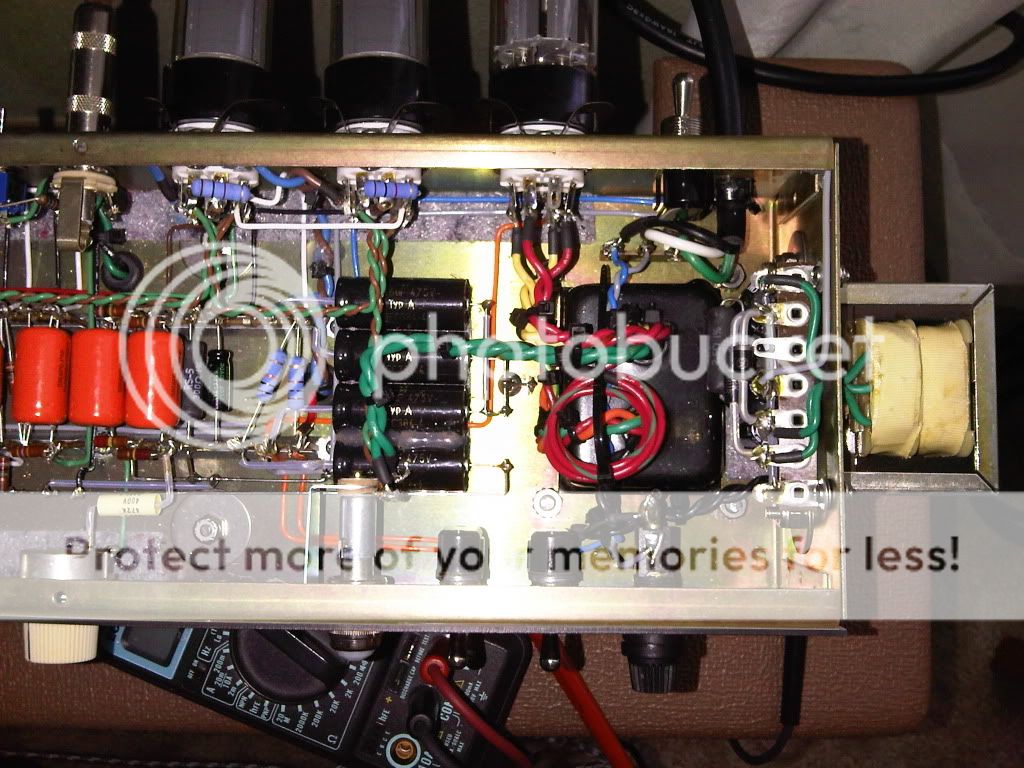
You can use JJ6V6s - they will go to 475V or even 500V easy and are 14Wers.
As to the voltage regulator ricks there's info on the Aiken site, and as far as limiting resistors go, Merlin B has a helpful article here (his new book is out now BTW)
As for the limiting resistors, what type/rating are recommended? I see some general info (not less that 7w...), but I'm wondering if limiting resistors can be installed without just adding (noticeably...) to the "sag". Perhaps in that situation a Zener on the B+ CT would still be best...
dehughes wrote:
As for the limiting resistors, what type/rating are recommended? I see some general info (not less that 7w...), but I'm wondering if limiting resistors can be installed without just adding (noticeably...) to the "sag". Perhaps in that situation a Zener on the B+ CT would still be best...
Given that they are dealing with VAC, which being a RMS value, is about .70 of the peak swing, then to be on the safe side I'd say that each resistor should be at least 2 x the power dissipated by each resistor using the VAC x 1.4 as a guide for voltage in the I x V equation. How rough is that?
dehughes wrote:
As for the limiting resistors, what type/rating are recommended? I see some general info (not less that 7w...), but I'm wondering if limiting resistors can be installed without just adding (noticeably...) to the "sag". Perhaps in that situation a Zener on the B+ CT would still be best...
Given that they are dealing with VAC, which being a RMS value, is about .70 of the peak swing, then to be on the safe side I'd say that each resistor should be at least 2 x the power dissipated by each resistor using the VAC x 1.4 as a guide for voltage in the I x V equation. How rough is that?
Very cool. Thanks man! I think I'm going to go the Zener route, though....
Okay, I'm sold. So, if I'm seeing 419v on the OT CT, and I want to get that down around 370-ish, I'd then want a 50v Zener, yes?
Will using this method impart any additional noise/hum/etc. into the chassis ground? That is, might I be messing up my (otherwise) quiet amp, unbeknownst to me?
Also, who the heck stocks a 25 or 50w reverse-polarity Zener? Can't seem to find any in stock...save for a 30v one (might do the trick, but I think I'd rather get at least a 45v reduction...).
I tried a 50V Zener in an AC15 build, and not only did it NOT drop 50V (only about 35V), but it also added some noise. I removed it.
I think the VVR idea is the best one. I was going to suggest it, but someone beat me to it. You'll reduce your voltages AND get a great additoinal feature in your amp. Besides, eners are expensive, so you might as well get more for your money.
Using a big resistor to drop the entire power supply will trigger sag if not class A. (You won’t have class A.) You would need a 10watter min IMHO. I use one on my 2 x el84 amp and I think it dissipates 3 watts or so at idle. Definitely sags. That's why the zener approach is better for you since you don't want increased sag. Diodes don't change their voltage drop based on the current draw whereas resistors do.
sliberty wrote:I tried a 50V Zener in an AC15 build, and not only did it NOT drop 50V (only about 35V), but it also added some noise. I removed it.
I think the VVR idea is the best one. I was going to suggest it, but someone beat me to it. You'll reduce your voltages AND get a great additoinal feature in your amp. Besides, eners are expensive, so you might as well get more for your money.
Something sounds wrong with this picture - did you use a bypass cap?
M Fowler wrote:Also, who the heck stocks a 25 or 50w reverse-polarity Zener?
NTE has a 25w 50v reverse zener.
Mark
Can I order from them like I can from Mouser or Newark, or are they just a distributor? They do have what I need...but I'm not clear how to get it from them...
If you can't find a 20W zener, you can use 4 x 5W 12V zeners in series, which will be the equivalent of a 20W 48V zener, or 5 x 5W 9V zeners in series, which would be 25W 45V.
When you do the zeners this way, leave the leads a bit longer and solder them to a tag strip to help dissipate the heat. (Bruce Collins recommend threading a copper penny over the leads to help radiate the heat, but I have never found this necessary to date. The straight zeners are more than sufficient IMHO.
But in most cases it seriously isn't an issue because in 95% of amps, you are talking about dropping the RMS voltage with only a couple of hundred milliamps at most (peak current draw) going through the HT centre tap, so say:
45V x 0.2A = 9W dissipation for something like a Fender Tweed Bassman.
A smaller amp like a 5E3 would have even less current demand than this on the zener. So 20W for 40-50V drop will be more than sufficient in most amps. Similarly, if you are only dropping 12V then 10W should be sufficient (of course, slightly more power handling ability is preferable to slightly less).
Also remember that the amount you zener down the B+ at the HT centre tap is not exactly linear to the amount that the B+ will drop, because you have to factor in the effect of rectifying and filtering that AC voltage coming off the HT winding. Whatever the zener drop on the centre tap, the voltage will drop slightly more on the B+ rail.
The NTE part (NTE5278AK -- a 56 volt, 50w, reverse polarity Zener) shows up as obsolete on a lot of sites. But Centrepointe ( http://www.cpcares.com) shows inventory at $15.35 for 1-4 or $13.82 for 5-9. Good prices compared to the rest of them.
You could also try calling Mouser to see if they can order the Solid State Inc. equivalent, but the search function there only shows the normal polarity version.
If these are getting hard to find, someone should stockpile a stash. Maybe AES could be convinced to carry them?
Hmm...I'm kinda wondering if I'd be better served to just buy a different PT that would provide the appropriate voltages, being as Zeners are tough to find, and I'm not sure I'd even have the space for one.

 Very cool. Thanks man! I think I'm going to go the Zener route, though....


 768]
768]