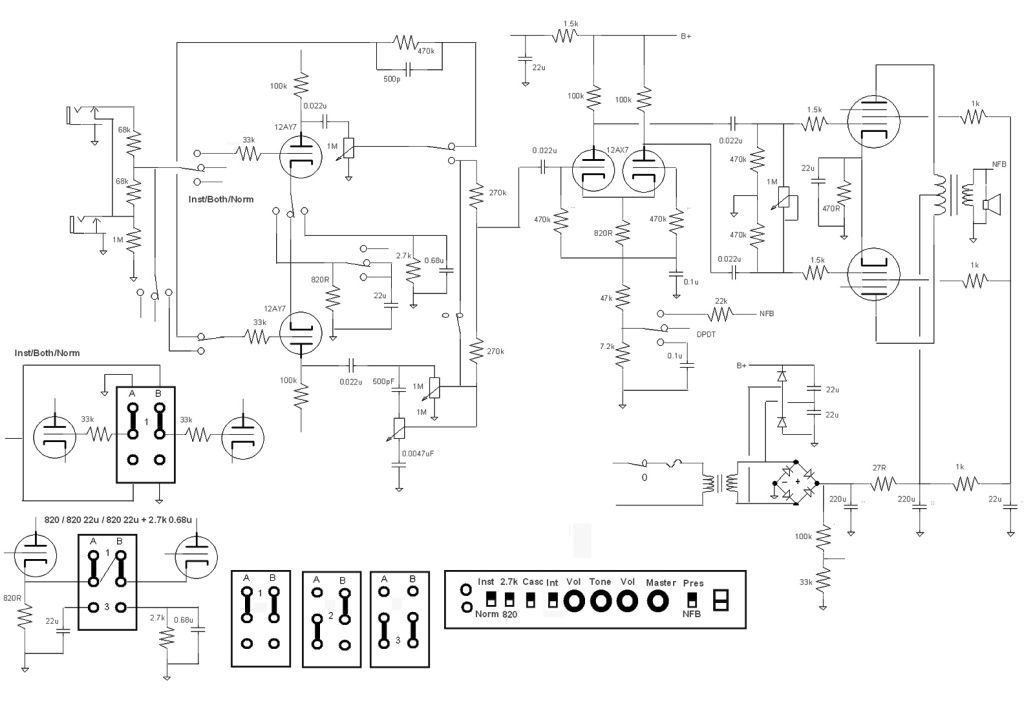
While I'm waiting for parts for my 50-watt build, help me think thru the input scheme. Here's the original:
[img:625:305]http://www.marshallamps.com/images/prod ... nelbig.jpg[/img]
Four jacks, high and low sens, channels 1 and 2.
I don't want to mess with a jumper cable, and I want to reduce the number of jacks to 2, hi and lo sens. I figured I'd add switches next to the volume 1 and volume 2 pots. See attached photos. Seems to work well, at least according to my ohmmeter. Signal for the two channels will go from center pin on switches to V1a and V1b.
But why switch the channels at all? Don't I get the same effect be turning the volume pots to zero?!? If I want channel 1, turn the volume for channel 2 off. Vice versa.
Let me know if you can think why I should keep or toss the switches.
Plexi, four-jack input scheme - trying to simplify
Moderators: pompeiisneaks, Colossal
Plexi, four-jack input scheme - trying to simplify

You do not have the required permissions to view the files attached to this post.
Re: Plexi, four-jack input scheme - trying to simplify
I'd dump the switches. With one jack feeding both tube grids, you have the same configuration as bridging two inputs, which is typically the way split cathode Marshalls are used. So you're right: using the volume controls should suffice. IMHO.
Re: Plexi, four-jack input scheme - trying to simplify
You're building in the one wire mod. Should work a treat without the switches.
Re: Plexi, four-jack input scheme - trying to simplify
I went through this process a few months ago. I wanted to be able to use one input to feed both channels if required, but also wanted to be able to use the channels independently. Generally with the band I use an A/B box to use one channel as 'rhythm /a bit overdriven' and other channel as 'brighter & more overdriven'; then use guitar vol control and boost pedal to fine tune.
I don't like using a link cable between channels (can't find one when needed) and can't see any use for -6dB padded inputs. Plus use of a regular link cable results in the input impedance being lowered and treble loss (due to increased input series resistance and Miller capacitence).
It's also handy to have independent access to both channels in case you want to jam with a buddy and that's the only amp knocking around.
I worked out an arrangement so that with 1 regular/mono and 1 stereo switching jack sockets, I could achieve all the above, such that -
Input A (Normal / Link) - plug into this ONLY to use both channels.
Input B (Lead) - plug into this to use 'Lead' channel; doing so disables the 'link' function, allowing the channels to be used independently.
As I see it, this two input socket arrangement does everything that the regular 4 input arrangement allows, other than the padded inputs, which I dislike anyway.
Pete
I don't like using a link cable between channels (can't find one when needed) and can't see any use for -6dB padded inputs. Plus use of a regular link cable results in the input impedance being lowered and treble loss (due to increased input series resistance and Miller capacitence).
It's also handy to have independent access to both channels in case you want to jam with a buddy and that's the only amp knocking around.
I worked out an arrangement so that with 1 regular/mono and 1 stereo switching jack sockets, I could achieve all the above, such that -
Input A (Normal / Link) - plug into this ONLY to use both channels.
Input B (Lead) - plug into this to use 'Lead' channel; doing so disables the 'link' function, allowing the channels to be used independently.
As I see it, this two input socket arrangement does everything that the regular 4 input arrangement allows, other than the padded inputs, which I dislike anyway.
Pete
You do not have the required permissions to view the files attached to this post.
Re: Plexi, four-jack input scheme - trying to simplify
There are toggle switches that are DPDT On-On-On but in the middle position only one pole switches so if you bridge the center terminals you get both inputs. You have to be careful though, I bought some switches fold as On-On-On and they turned out being regular DPDT On-Off-On.
[img 709]http://i406.photobucket.com/albums/pp14 ... 6amp-1.jpg[/img]
[img
 709]http://i406.photobucket.com/albums/pp14 ... 6amp-1.jpg[/img]