I am thinking of pressing in my amp-building skills by adding a relay, or two, to my blackface style build so I can have foot -switchable mid boost, and brite.
But I don't much about relays..could anyone point me to a good online tutorial if you know of one? Or, your own explanation.
some questions:
1) how close does relay need to be to switched circuit terminals?
2) Separate tranny for the relays, or use the power-supply tranny heater-ouptut?
teach me about relays
Moderators: pompeiisneaks, Colossal

Re: teach me about relays
http://www.electronics-tutorials.ws/io/io_5.html
1.) The closer the better, keeping signal leads to a minimum.
2.) I would run a dedicated supply, independant of the filament supply.
TM
1.) The closer the better, keeping signal leads to a minimum.
2.) I would run a dedicated supply, independant of the filament supply.
TM
You do not have the required permissions to view the files attached to this post.
Re: teach me about relays
1) be sure each switching contact (NC, NO and C) always has a DC path to GND - 20M is a fine value if you need to add one.
2) put at least one of a diode or a 0.1uF cap in parallel with the coil to trap 'flyback' currrents so they don't wind up inducing noise in the switching contacts.
3) some relay coil power supplies require isolation from GND - use isolated jacks to connect to footswitch if this is the case.
4) isolate coil wiring from signal wiring - DO NOT use the same ground runs.
Hope this helps!
2) put at least one of a diode or a 0.1uF cap in parallel with the coil to trap 'flyback' currrents so they don't wind up inducing noise in the switching contacts.
3) some relay coil power supplies require isolation from GND - use isolated jacks to connect to footswitch if this is the case.
4) isolate coil wiring from signal wiring - DO NOT use the same ground runs.
Hope this helps!
-
JamesHealey
- Posts: 477
- Joined: Thu Aug 28, 2008 5:34 pm
- Location: Leeds, UK
Re: teach me about relays
Don,
Can you draw me a schematic of this idea with 20M DC reference and flyback noise reduction.
Would make life easier, i've only ever made one amp with channel switching and it was plagued with switching noise.
Can you draw me a schematic of this idea with 20M DC reference and flyback noise reduction.
Would make life easier, i've only ever made one amp with channel switching and it was plagued with switching noise.
Re: teach me about relays
Try this HRDeluxe: http://www.prowessamplifiers.com/schema ... _0696.html
Note K1A (Zone D7) has a DC path to GND on each terminal, as does K1B (Zone D5) and the diode across the coils (orientation is important!) in Zone C5.
If you're modding an amp, and you're switching a signal that doesn't have a DC path, add one with a large-value resistor.
Hope this helps!
Note K1A (Zone D7) has a DC path to GND on each terminal, as does K1B (Zone D5) and the diode across the coils (orientation is important!) in Zone C5.
If you're modding an amp, and you're switching a signal that doesn't have a DC path, add one with a large-value resistor.
Hope this helps!
-
guitarmike2107
- Posts: 303
- Joined: Fri Dec 12, 2008 10:51 pm
- Location: East Scotland
- Contact:
Re: teach me about relays
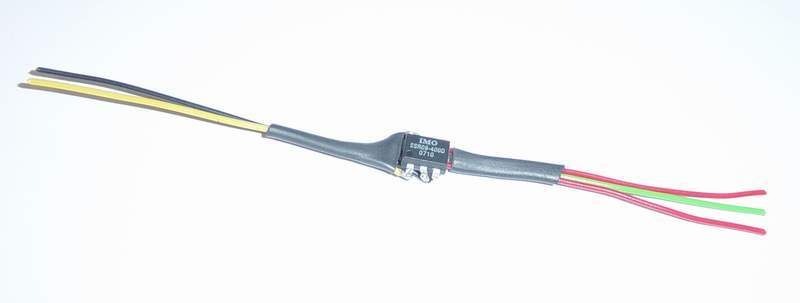
Or use solid state relays so you don’t have coils and flybackDonMoose wrote: 2) put at least one of a diode or a 0.1uF cap in parallel with the coil to trap 'flyback' currrents so they don't wind up inducing noise in the switching contacts.
3) some relay coil power supplies require isolation from GND - use isolated jacks to connect to footswitch if this is the case.
4) isolate coil wiring from signal wiring - DO NOT use the same ground runs.
Heres one I did earlier, I put on flying leads so it could be used on a turret board.
http://i171.photobucket.com/albums/u292 ... C05462.jpg

Re: teach me about relays
Hey Mike,guitarmike2107 wrote:Or use solid state relays so you don’t have coils and flybackDonMoose wrote: 2) put at least one of a diode or a 0.1uF cap in parallel with the coil to trap 'flyback' currrents so they don't wind up inducing noise in the switching contacts.
3) some relay coil power supplies require isolation from GND - use isolated jacks to connect to footswitch if this is the case.
4) isolate coil wiring from signal wiring - DO NOT use the same ground runs.
Heres one I did earlier, I put on flying leads so it could be used on a turret board.
http://i171.photobucket.com/albums/u292 ... C05462.jpg
Can you expand a little more on that device?
Like what is the part and a link to a data sheet?
THanks.
Tom
Don't let that smoke out!
Don't let that smoke out!
-
guitarmike2107
- Posts: 303
- Joined: Fri Dec 12, 2008 10:51 pm
- Location: East Scotland
- Contact:
Re: teach me about relays
You have to check the datasheets for these as they all work differently. Obviously make sure it can handle the voltage, has a low on resistance, doesn’t require a minimum load current to work etc
For foot switching the on/off times should probably be checked too. I am using them as a RoHS friendly alternative to LDR’s for switching
That one in my photo above is this one
http://www.rapidonline.com/netalogue/specs/60-2064.pdf
and I currently have three of these on the bench I am testing. Also added the flying leads for turret installations
http://uk.rs-online.com/web/search/sear ... R=693-6911
Here’s a data sheet for another one I have looked at using, I never order from Farnell who stock them so that’s why I haven’t tried them yet
http://www.avagotech.com/docs/AV02-0453EN
I haven’t used them for footswitching applications, only for function switches where I want to switch more than one thing at a time. Normally used in a shunt application too. Cheap enough to experiment with.
For foot switching the on/off times should probably be checked too. I am using them as a RoHS friendly alternative to LDR’s for switching
That one in my photo above is this one
http://www.rapidonline.com/netalogue/specs/60-2064.pdf
and I currently have three of these on the bench I am testing. Also added the flying leads for turret installations
http://uk.rs-online.com/web/search/sear ... R=693-6911
Here’s a data sheet for another one I have looked at using, I never order from Farnell who stock them so that’s why I haven’t tried them yet
http://www.avagotech.com/docs/AV02-0453EN
I haven’t used them for footswitching applications, only for function switches where I want to switch more than one thing at a time. Normally used in a shunt application too. Cheap enough to experiment with.
Re: teach me about relays
Pula58,
When you get around to implementing your relays, I suggest that you reach out to Ampdoc1 (a long standing member of this forum) for the hardware.
He has designed and manufactured a Triple Relay PCB with Power Supply that has worked fantastically in a couple of my Dumble'esqe and amp head switcher builds. It taps into your 6.3 V heater power supply, is very compact and dead quiet. It is very reasonably priced and he is a helluva nice guy to work with if you have any questions/problems!
Cruise around the Dumble areas (Discussion and Files) of this forum and you will likely see them in use in many of the layouts that the good folks here post up. I do have a schematic/layout of a version of his product but don't know if it is kosher to just post it up here. Hopefully he and/or others will let us know about that.
Regardless, he has taken all of the implementation worries out of the equation and I highly recommend that you check it out to see if it suits you and your situation.
Good luck,
Dave O.
When you get around to implementing your relays, I suggest that you reach out to Ampdoc1 (a long standing member of this forum) for the hardware.
He has designed and manufactured a Triple Relay PCB with Power Supply that has worked fantastically in a couple of my Dumble'esqe and amp head switcher builds. It taps into your 6.3 V heater power supply, is very compact and dead quiet. It is very reasonably priced and he is a helluva nice guy to work with if you have any questions/problems!
Cruise around the Dumble areas (Discussion and Files) of this forum and you will likely see them in use in many of the layouts that the good folks here post up. I do have a schematic/layout of a version of his product but don't know if it is kosher to just post it up here. Hopefully he and/or others will let us know about that.
Regardless, he has taken all of the implementation worries out of the equation and I highly recommend that you check it out to see if it suits you and your situation.
Good luck,
Dave O.

Re: teach me about relays
A properly oriented diode across the coil is pretty much standard issue on nearly all DC operated relays these days.DonMoose wrote:2) put at least one of a diode or a 0.1uF cap in parallel with the coil to trap 'flyback' currrents so they don't wind up inducing noise in the switching contacts.
Some relays even have this diode incorporated into the relay itself.
So, yeah, definitely use a diode and the cap is a good idea too for amps where noise suppression is an issue.
rd
Re: teach me about relays
Dave O,
Thanks for the kind words. I don't have any more of those boards, but I gave my PCB design to Curt, and he had some built. Probably still has some for sale.
Curt Granger <curt@grangeramp.com>
For myself, I'm using OPTO-MOS devices in my designs now. I like the Clare devices (pg 1792 of the latest Mouser catalog). They are available as 2-NO, 2-NC, or 1-NC/1-NO. These are a little more expensive, and take twice the number of devices to = a DPDT relay. But, in the big scheme of things it's a pretty small part of the cost of an amp. And there is NO switching noise vs. a small click with relays.
Also, I installed my relay boards in several amps using the 6.3V heater or the 5V (typically unused) tap, and had 0 hum.
a'doc1
Thanks for the kind words. I don't have any more of those boards, but I gave my PCB design to Curt, and he had some built. Probably still has some for sale.
Curt Granger <curt@grangeramp.com>
For myself, I'm using OPTO-MOS devices in my designs now. I like the Clare devices (pg 1792 of the latest Mouser catalog). They are available as 2-NO, 2-NC, or 1-NC/1-NO. These are a little more expensive, and take twice the number of devices to = a DPDT relay. But, in the big scheme of things it's a pretty small part of the cost of an amp. And there is NO switching noise vs. a small click with relays.
Also, I installed my relay boards in several amps using the 6.3V heater or the 5V (typically unused) tap, and had 0 hum.
a'doc1
-
guitarmike2107
- Posts: 303
- Joined: Fri Dec 12, 2008 10:51 pm
- Location: East Scotland
- Contact:
Re: teach me about relays
here is page 1792 of the online mouser catalogue.
http://www.mouser.com/catalog/643/1792.Pdf ??
I take it you meant these Clare devices
http://uk.mouser.com/catalog/643/1850.pdf
http://www.mouser.com/catalog/643/1792.Pdf ??
I take it you meant these Clare devices
http://uk.mouser.com/catalog/643/1850.pdf
Re: teach me about relays
Thanks Mike!
I thought I had the latest paper catalog, but it must not correspond to the online cat.
Those are the CLARE devices I was referencing.
I thought I had the latest paper catalog, but it must not correspond to the online cat.
Those are the CLARE devices I was referencing.