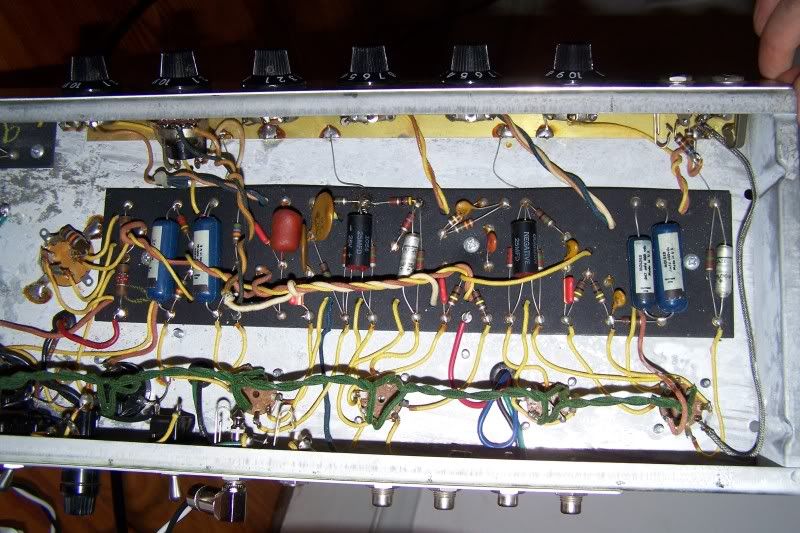
Help me troubleshoot my in progress Princeton build.

General discussion area for tube amps.

Moderators: pompeiisneaks, Colossal

User avatar
ChrisM
Posts: 1169
Joined: Wed Oct 22, 2008 11:12 pm
Location: Toronto, Canada.

Re: Help me troubleshoot my in progress Princeton build.

Post by ChrisM »

tribi9 wrote:
ChrisM wrote:What happened with the VC? You worked so hard to get it going, now your using it's chassis?
Yeah, I wasn't happy with it.

Where is the cathode resistor in the schematic tho'? I can't locate it. The cathode on the schem doesn't show a resistor coming out of it. :?


http://www.ampwares.com/schematics/princeton_aa964.pdf
That's because that amp is fixed-bias. A negative (with respect to cathode) voltage is applied to the control grid of the tubes to set their "idle".

You could make the amp cathode bias if you want. Would make things simplier, easier, less parts. It will be a different sound though.
User avatar
tribi9
Posts: 571
Joined: Tue Nov 11, 2008 11:01 pm
Location: KW in ON, Canada.

Re: Help me troubleshoot my in progress Princeton build.

Post by tribi9 »

ChrisM wrote:
tribi9 wrote:
ChrisM wrote:What happened with the VC? You worked so hard to get it going, now your using it's chassis?
Yeah, I wasn't happy with it.

Where is the cathode resistor in the schematic tho'? I can't locate it. The cathode on the schem doesn't show a resistor coming out of it. :?


http://www.ampwares.com/schematics/princeton_aa964.pdf
That's because that amp is fixed-bias. A negative (with respect to cathode) voltage is applied to the control grid of the tubes to set their "idle".

You could make the amp cathode bias if you want. Would make things simplier, easier, less parts. It will be a different sound though.


Gotcha! So the voltage divider resistors is what Im beefing up. Thank you.
User avatar
tribi9
Posts: 571
Joined: Tue Nov 11, 2008 11:01 pm
Location: KW in ON, Canada.

Re: Help me troubleshoot my in progress Princeton build.

Post by tribi9 »

So in the princeton schematic I guess the power tubes are fixed bias and the two 9 pin tubes are cathode biased... lol. Makes so much sense now.


Thx for your patience guys. :)
tubeswell
Posts: 2337
Joined: Thu Mar 27, 2008 6:42 am
Location: Wellington. NZ

Re: Help me troubleshoot my in progress Princeton build.

Post by tubeswell »

FWIW, with cathode bias the bias is obtained by making the cathode +ve with respect to the grid (which is at 0 V), whereas with fixed bias the bias is obtained by making the grid -ve with respect to the cathode (which is at 0V).

Therefore, with fixed bias, you get more gain with the same plate and screen voltage, because the voltage between the cathode and the plate (which is what counts for gain) is greater than it is with cathode bias.

However in cathode bias, you can bias the stage right up to 100% of its maximum-rated dissipation, because the cathode resistor acts to 'put a brake on' increases in tube current during the signal swing. As the current flowing through the cathode resistor increases, the cathode voltage also increases accordingly (because the cathode resistance is constant - remember ohms law? V = I x R), which therefore increases the amount of bias, which therefore brings the tube into equilibrium.

That is why, in fixed bias, you have to idle the tubes at lower than their maximum rated dissipation, because there is nothing to counteract rises in tube current during the signal swing, and you need to leave a buffer so that the tube can handle those increases in current. Hence we (usually ;-) ) bias the power tubes at around 70% or lower of the maximum rated dissipation. 2CW
User avatar
tribi9
Posts: 571
Joined: Tue Nov 11, 2008 11:01 pm
Location: KW in ON, Canada.

Re: Help me troubleshoot my in progress Princeton build.

Post by tribi9 »

Thank you tubeswell. Im going to be using all this info soon.

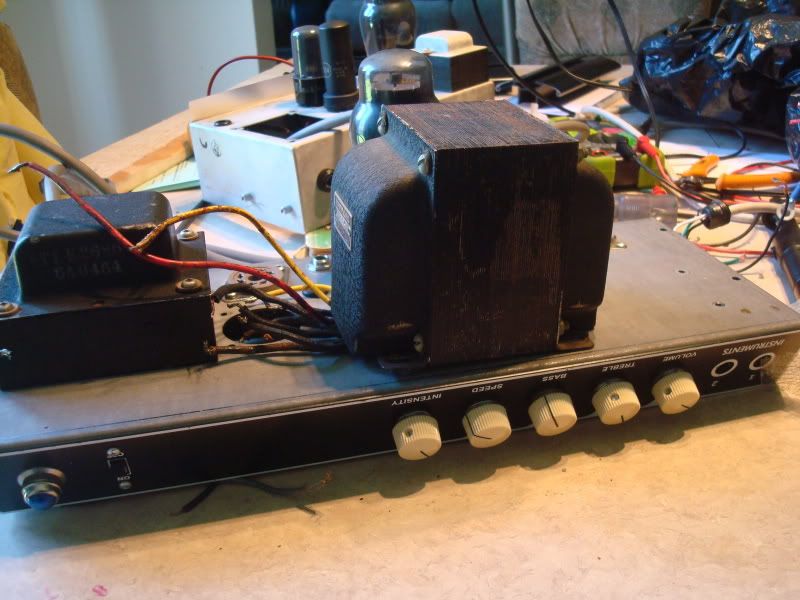
So i scored an old Hammond 60W OT rated at 3.8K with multiple secondaries. It has 4,8,15,30,250 and 500 ohm secondaries. It is big but It'll fit fine. I plan to get a head cabinet eventually.

The problem here is that I have only Id'd the primary wires, b+ on the primary and ground on the secondary. The guy I bought the transformer from said that If mentioned resistance from the secondary to the common wire. I should be able to tell. The highest resistance should be the 500 ohm, followed by the second highest being the 250 ohm and so on.

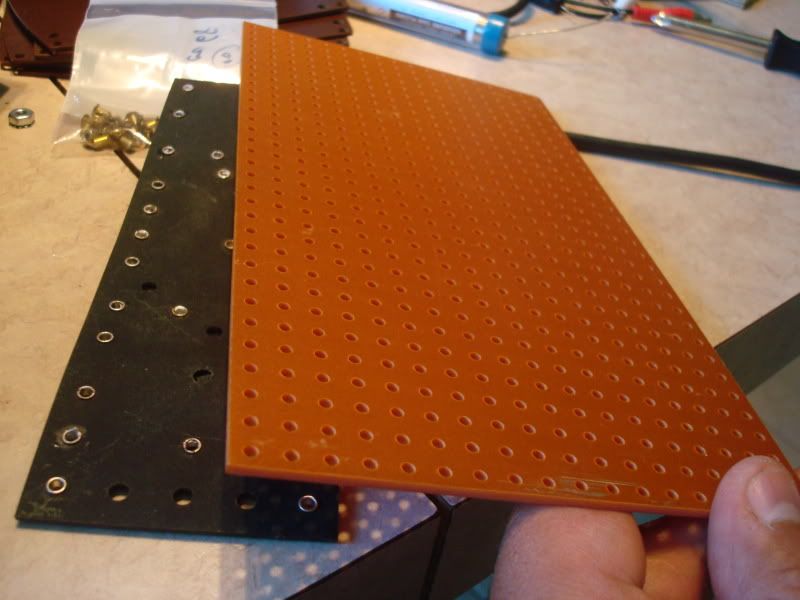
I also cleaned up the old vibrochamp board. I'm pretty sure I can make it work on that board. For the diode and bias circuit board I got this brown perforated board. It is the same thickness as the black board and I also got some eyelets. I'll have to make it as small as possible.

I was going to get some proper board material and make a custom board but screw it. I spent a lot of money building that champ. So Im going to recycle as much as I can from it. I was going to go for prettiness but now im going for a mix of recycleability and functionality. I'll still try to be somewhat neat tho'


I'm only a few diodes and some resistors away to start putting it together now,

[IMG:800:600]http://i114.photobucket.com/albums/n271 ... C02623.jpg[/img]

[IMG:800:600]http://i114.photobucket.com/albums/n271 ... C02621.jpg[/img]

:D
User avatar
Structo
Posts: 15446
Joined: Wed Oct 17, 2007 1:01 am
Location: Oregon

Re: Help me troubleshoot my in progress Princeton build.

Post by Structo »

Man that OT is huge! :shock:

Best of luck on your project!
Tom

Don't let that smoke out!
User avatar
tribi9
Posts: 571
Joined: Tue Nov 11, 2008 11:01 pm
Location: KW in ON, Canada.

Re: Help me troubleshoot my in progress Princeton build.

Post by tribi9 »

Thread renamed to reflect the change....

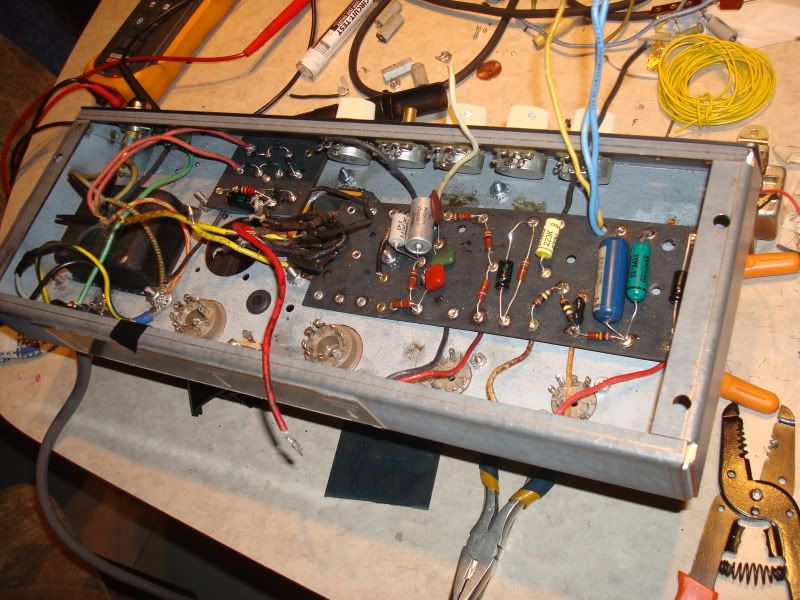
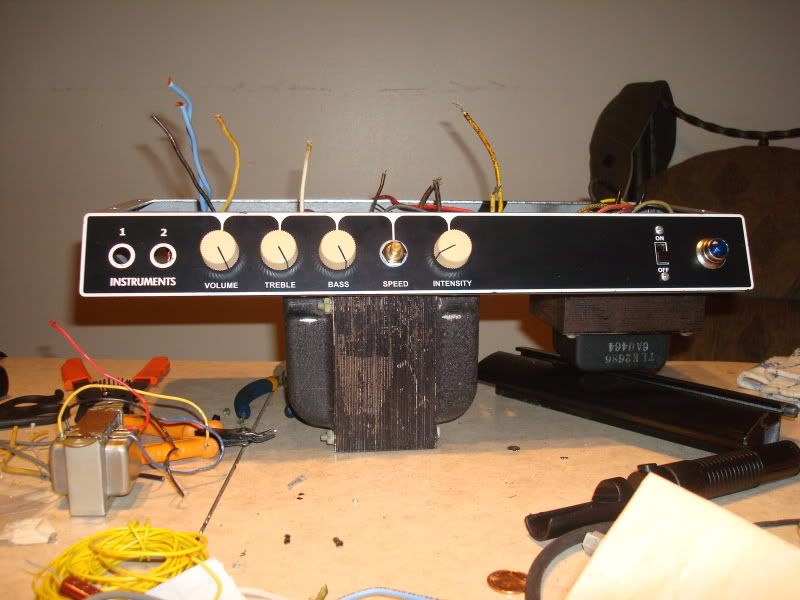
So am a few resistors and a can cap away to get my Princeton AA1164 going, oh and plus a little wiring too. I made the eyelet board for the rectifier bridge + bias circuit and wired up the mains to the rectifier bridge and the light switch...

The only problem here is that I'm only getting 325 rectified DCV measured to ground with no load! (I'm measuring from where the two diodes meet at the one end of the board) I'm using six diodes in parallel. Three per primary side.

So my question.... What does this mean? Is this not going to work anymore with the 6L6g's and my 3.8K OT? I drilled a huge hole for the OT on the chassis plus I also enlarged the PT cutout to fit this one, so Im kinda screwed if this can't work... :(

[IMG:800:600]http://i114.photobucket.com/albums/n271 ... C02654.jpg[/img]

[IMG:800:600]http://i114.photobucket.com/albums/n271 ... C02655.jpg[/img]
User avatar
ChrisM
Posts: 1169
Joined: Wed Oct 22, 2008 11:12 pm
Location: Toronto, Canada.

Re: Help me troubleshoot my in progress Princeton build.

Post by ChrisM »

Do you have a filter cap after the recto? If not install a filter cap then remeasure.
User avatar
tribi9
Posts: 571
Joined: Tue Nov 11, 2008 11:01 pm
Location: KW in ON, Canada.

Re: Help me troubleshoot my in progress Princeton build.

Post by tribi9 »

No Chris, not yet. i will hook it up and take a reading again.

Another question... Since I need to up the 220K voltage dividers to around 400k 10 watts gor the 6l6gs, I checked around and the only 10 watts at that value I can get are wirewounds and physically huge. The schematic calls for two 220K 5%. Why does it give a percentage instead of a wattage rating?

By looking at a pic I of a real princeton I can see that the voltage dividers aren't huge in size.

I got a couple of 400K 1/2 watts. Would I be able to use those ?

Thanks in advance.


http://www.ampwares.com/schematics/princeton_aa964.pdf

[IMG:800:533]http://i114.photobucket.com/albums/n271 ... ueprin.jpg[/img]
User avatar
Structo
Posts: 15446
Joined: Wed Oct 17, 2007 1:01 am
Location: Oregon

Re: Help me troubleshoot my in progress Princeton build.

Post by Structo »

Are you talking about the two 220K bias feed resistors?
That is a common value and 1/2 watt is sufficient but I like to use at least 1 watt resistors because they are a bit bigger and are easier to work with/
The 5% is the tolerance of the resistor.
The actual value will be +- 5% of the rated value.
Tom

Don't let that smoke out!
User avatar
tribi9
Posts: 571
Joined: Tue Nov 11, 2008 11:01 pm
Location: KW in ON, Canada.

Re: Help me troubleshoot my in progress Princeton build.

Post by tribi9 »

Structo wrote:Are you talking about the two 220K bias feed resistors?
That is a common value and 1/2 watt is sufficient but I like to use at least 1 watt resistors because they are a bit bigger and are easier to work with/
The 5% is the tolerance of the resistor.
The actual value will be +- 5% of the rated value.
Thank you.

On a cathode biased circuit you'd up the cathode resistor to run the 6l6g's right? I thought I'd have to up the 220K bias feed resistor. but Im not sure now which resistor I need to up to run the 6L6G's on the fixed bias Princeton now... Do i even have to up anything being that is fixed bias?
tubeswell
Posts: 2337
Joined: Thu Mar 27, 2008 6:42 am
Location: Wellington. NZ

Re: Help me troubleshoot my in progress Princeton build.

Post by tubeswell »

tribi9 wrote:
Structo wrote:Are you talking about the two 220K bias feed resistors?
That is a common value and 1/2 watt is sufficient but I like to use at least 1 watt resistors because they are a bit bigger and are easier to work with/
The 5% is the tolerance of the resistor.
The actual value will be +- 5% of the rated value.
Thank you.

On a cathode biased circuit you'd up the cathode resistor to run the 6l6g's right? I thought I'd have to up the 220K bias feed resistor. but Im not sure now which resistor I need to up to run the 6L6G's on the fixed bias Princeton now... Do i even have to up anything being that is fixed bias?
The power rating of the resistor is dependent on the voltage that is being dropped across the resistor - remember current = voltage/resistance (I=E/R), and voltage x current = power (ExI=W). In this case 0.5W rating is ample because the voltage dropped across the 220k is only about 1/2 a volt.

But what you probably do need to change if you put 6L6s in, is to increase the negative bias voltage being supplied to the grids (via the 2 x 220k), and to 1/2 the load-resistance being reflected through the output transformer (as well as increasing the B+ and plate and screen voltages a bit).

You probably also will want to alter the trem oscillator output voltage (i.e.; e.g.; by decreasing that 1M build-out resistor to something like 470k or 220k), because the increased bias voltage of 6L6s requires more LFO voltage gradient to get it to slam properly. Those bias-wiggle trem circuits are designed to work optimally with particular output tubes.
User avatar
tribi9
Posts: 571
Joined: Tue Nov 11, 2008 11:01 pm
Location: KW in ON, Canada.

Re: Help me troubleshoot my in progress Princeton build.

Post by tribi9 »

tubeswell wrote:
But what you probably do need to change if you put 6L6s in, is to increase the negative bias voltage being supplied to the grids (via the 2 x 220k), and to 1/2 the load-resistance being reflected through the output transformer (as well as increasing the B+ and plate and screen voltages a bit).
Ok so just lower the 220K to whatever gets me a 70% dissipation on the tube then.

To 1/2 the load resistance being reflected through the plate you mean to just swap my 1K1W to a 500 ohm1W?
tubeswell
Posts: 2337
Joined: Thu Mar 27, 2008 6:42 am
Location: Wellington. NZ

Re: Help me troubleshoot my in progress Princeton build.

Post by tubeswell »

tribi9 wrote:
tubeswell wrote:
But what you probably do need to change if you put 6L6s in, is to increase the negative bias voltage being supplied to the grids (via the 2 x 220k), and to 1/2 the load-resistance being reflected through the output transformer (as well as increasing the B+ and plate and screen voltages a bit).
Ok so just lower the 220K to whatever gets me a 70% dissipation on the tube then.
No you leave the 220k alone. You increase the negative voltage going to the 'bottom' end of the 220k by changing the bias supply voltage divider (which in the AA1164 is the 22k to ground from the intensity pot, or if you have made an adjustable fixed bias supply - by turning up the resistance on your bias supply pot)
tribi9 wrote:To 1/2 the load resistance being reflected through the plate you mean to just swap my 1K1W to a 500 ohm1W?
No the load resistance is the load that the output tubes 'see' through the output transformer from the speaker. If your OT has multiple secondary taps, then you would plug your speaker into a higher impedance tap to reflect a lower load resistance to the output tubes. Say you had an 8R speaker, and your OT a 4R and 8R and 16R secondary tap - you plug the 8R speaker into the 16R tap, and this halves the load resistance.

Alternatively if you OT only had one (say 8R) speaker tap for the secondary, you would wire in a lower (i.e. 4R) impedance speaker
User avatar
tribi9
Posts: 571
Joined: Tue Nov 11, 2008 11:01 pm
Location: KW in ON, Canada.

Re: Help me troubleshoot my in progress Princeton build.

Post by tribi9 »

tubeswell wrote:
No you leave the 220k alone. You increase the negative voltage going to the 'bottom' end of the 220k by changing the bias supply voltage divider (which in the AA1164 is the 22k to ground from the intensity pot, or if you have made an adjustable fixed bias supply - by turning up the resistance on your bias supply pot)
tribi9 wrote:To 1/2 the load resistance being reflected through the plate you mean to just swap my 1K1W to a 500 ohm1W?
No the load resistance is the load that the output tubes 'see' through the output transformer from the speaker. If your OT has multiple secondary taps, then you would plug your speaker into a higher impedance tap to reflect a lower load resistance to the output tubes. Say you had an 8R speaker, and your OT a 4R and 8R and 16R secondary tap - you plug the 8R speaker into the 16R tap, and this halves the load resistance.

Alternatively if you OT only had one (say 8R) speaker tap for the secondary, you would wire in a lower (i.e. 4R) impedance speaker
Oh Ok, sorry you confused me about halving the load as I already have an OT rated at 3.8k and that is what the 6l6G's want to see that in AB push pull.

I got 2 resistors in series that total 10K. I will swap those for the 22K voltage divider to increase the negative voltage then.
Post Reply