I have a build that i put together probably 6 months ago. It has a hammond marshall replacement OT and 2 cathode biased EL34's. I used seperate cathode resistors ala matchless chieftain and badcat, but i did something they didn't.....i made the cathode bypass caps switchable to take them out of circuit completely. The reason i did this is that i found with no caps the amp sounds amazing. It also drops the volume a lot, much more than a 1/2 power switch.
Anyway, here what i want to know. The main difference in sound is that with the caps switched out the amp displays a very healthy amount of squish. It's just fantastic. But with the caps switched in that squish is much lessened. I have tried values from 1uf to hundreds of UF and settled on 22uf, b ut the point is no value has any affect on that squish factor. No matter what caps i use the amp always sounds worlds squishier without them. And i always turn the volume up on the no cap setting to match the volume i get with the caps so that when A/B'ing the 2 settings i know it's not the volume difference that accounts for the squish factor.
So the 2 questions i have are why this happens, and the second is do you know any way i can recreate that same squish when the caps are in circuit. i wouldn't even bother but in higher volume situations i would need the caps switched in because the amp is much louder.
Cathode biased EL34 question
Moderators: pompeiisneaks, Colossal
-
iknowjohnny
- Posts: 1070
- Joined: Thu Apr 24, 2008 2:10 am
- Location: los angeles
Re: Cathode biased EL34 question
The cathode resistor creates the DC bias point for the tube to operate, so that, with plate voltage and other factors impact basic output power.
The bypass cap shunts the signal voltage present at the top of the cathode resistor to ground. Since this signal voltage is 180 degrees out of phase with the signal on the plate, it acts as a form of negative feedback in the tube. The bypass cap eliminates this negative feedback. This is why, in a preamp tube, for example, the bypass cap increases gain.
So, removing the bypass cap from the power tubes restores a bit of negative feedback operating in the tube, which can change the dynamic response of the tube, as you've experienced.
The bypass cap shunts the signal voltage present at the top of the cathode resistor to ground. Since this signal voltage is 180 degrees out of phase with the signal on the plate, it acts as a form of negative feedback in the tube. The bypass cap eliminates this negative feedback. This is why, in a preamp tube, for example, the bypass cap increases gain.
So, removing the bypass cap from the power tubes restores a bit of negative feedback operating in the tube, which can change the dynamic response of the tube, as you've experienced.
Rich Gordon
www.myspace.com/bigboyamplifiers
"The takers get the honey, the givers get the blues." --Robin Trower
www.myspace.com/bigboyamplifiers
"The takers get the honey, the givers get the blues." --Robin Trower
-
collinsamps
- Posts: 223
- Joined: Fri Mar 06, 2009 1:51 pm
- Location: North Carolina
- Contact:
another analogy
Well put,
Another way to make it understandable in lamens terms is to think in terms of DC and AC being present on the cathode. The DC bias voltage is set by the resistor(voltage subtracted from the plate voltage to determine actual difference of potential IE bias voltage). With no capacitor to effect AC to ground current flow you have no control of frequency being amplified. By adding the cap ac flows through the capacitor to ground and you actually control the amplified frequency by selecting cap values with different charge/discharge times in relation to the amount of cathode current flow. Just like a bright cap on a volume pot, the frequency allowed to pass and not be attenuated by the cathode resistor is determined by the bypass cap size. Hence a volume increase(AC signal flow) when it's added.
A nice trick in preamp tubes for lower gain(tweeds running 12ax7's for example) but the power stage isn't the place to cut freq's for a good sounding amp.
http://www.tpub.com/neets/book6/0041.GIF
Another way to make it understandable in lamens terms is to think in terms of DC and AC being present on the cathode. The DC bias voltage is set by the resistor(voltage subtracted from the plate voltage to determine actual difference of potential IE bias voltage). With no capacitor to effect AC to ground current flow you have no control of frequency being amplified. By adding the cap ac flows through the capacitor to ground and you actually control the amplified frequency by selecting cap values with different charge/discharge times in relation to the amount of cathode current flow. Just like a bright cap on a volume pot, the frequency allowed to pass and not be attenuated by the cathode resistor is determined by the bypass cap size. Hence a volume increase(AC signal flow) when it's added.
A nice trick in preamp tubes for lower gain(tweeds running 12ax7's for example) but the power stage isn't the place to cut freq's for a good sounding amp.
http://www.tpub.com/neets/book6/0041.GIF
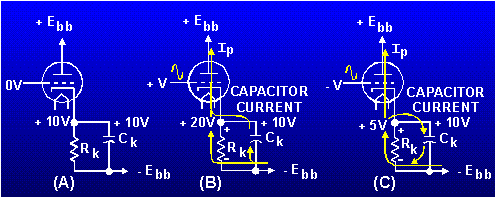
Re: Cathode biased EL34 question
Well there you go. When you're cranking the amp up without the caps, you're operating much less efficiently, drawing more current from the power supply than you would be at a matched volume with cathode bypass caps.iknowjohnny wrote: i always turn the volume up on the no cap setting to match the volume i get with the caps so that when A/B'ing the 2 settings i know it's not the volume difference that accounts for the squish factor.
So it seems quite possible to me that you're getting the squish from your power supply. Ways to increase this are to insert a sag resistor if you're SS-rectified, or to use a saggier rectifier tube, if that's what you're using. INcreasing screen resistor values will also increase compression/squish.
Life is a tale told by an idiot -- full of sound and fury, signifying nothing.
...in other words: rock and roll!
...in other words: rock and roll!
-
iknowjohnny
- Posts: 1070
- Joined: Thu Apr 24, 2008 2:10 am
- Location: los angeles
Re: Cathode biased EL34 question
I'm a bit confused on this. I'm not sure if you are saying you should or shouldn't have caps in a cathode biased PA because afaik all cathode biased amps usually have them, which in itself would seem to say that i should have caps there. But on the other hand you say you shouldn't cut frequencies in a PA yet thats exactly what those caps are doing since they are selective. Unless you are saying that the caps should be huge as to not roll off anything? The amp definatly sounds better without them. thats something i am quite sure most anyone who likes high gain marshall tone would agree with w/o a doubt.A nice trick in preamp tubes for lower gain(tweeds running 12ax7's for example) but the power stage isn't the place to cut freq's for a good sounding amp.
-
collinsamps
- Posts: 223
- Joined: Fri Mar 06, 2009 1:51 pm
- Location: North Carolina
- Contact:
Re: Cathode biased EL34 question
What I'm saying is this, and it's purely an opinion of how I would do it.
Let the power stage amplify the frequencies that is was designed to amplify by selecting a baypass cap that passes most anything that hits it from the preamp. IE stock value.
If you want to shape frequency amplification with cathode bypass caps do it with preamp bypass caps instead(not unlike attenuating frequencies with a tone stack between stages).
I wouldn't set the chokepoint at the exit, I would do it early on and let the entire amp amplify what I wanted it to instead of remove what I didn't want it to at the end. Tone shaping components are place directly after the first gain stage for this reason.
Also, when you take the cathode bypass cap out of the power stage you are also cutting the gain of the power stage substantially(meaning lower wattage out). If you really want lower power amplification change the value of the cathode resistor to get there faster. Even install a selector switch for 2 or 3 values/wattages.
Again, just what I would do. To each his own.
Let the power stage amplify the frequencies that is was designed to amplify by selecting a baypass cap that passes most anything that hits it from the preamp. IE stock value.
If you want to shape frequency amplification with cathode bypass caps do it with preamp bypass caps instead(not unlike attenuating frequencies with a tone stack between stages).
I wouldn't set the chokepoint at the exit, I would do it early on and let the entire amp amplify what I wanted it to instead of remove what I didn't want it to at the end. Tone shaping components are place directly after the first gain stage for this reason.
Also, when you take the cathode bypass cap out of the power stage you are also cutting the gain of the power stage substantially(meaning lower wattage out). If you really want lower power amplification change the value of the cathode resistor to get there faster. Even install a selector switch for 2 or 3 values/wattages.
Again, just what I would do. To each his own.
-
iknowjohnny
- Posts: 1070
- Joined: Thu Apr 24, 2008 2:10 am
- Location: los angeles
Re: Cathode biased EL34 question
It's not a kit or a production amp. i built it from scratch using bits and pieces of standard designs and a few boutique amps like the cathode biased el34 matchless and then took it from there.So there is no stock value. But i did find that i prefer the tone when the caps are lower values to keep the low end and low mids in check. As for doing any shaping in the front, i already spend months doing that and got it to the point that i have tried everything imaginable and nothing improves it. Not that it needs improving, as it sound amazing now which is why nothing i try anymore seems to improve it. but i have come to the conclusion that it IS the PA that needs perfecting. But only when caps are used. like i said, it sounds fantastic with no caps.Let the power stage amplify the frequencies that is was designed to amplify by selecting a baypass cap that passes most anything that hits it from the preamp. IE stock value
I've tried both many times but i keep finding the amp best without a sag R and with the screens at their current value. In fact it just seems so perfect right now noth seems to improve it....it's just that i want the same sound with the caps as w/o. and those 2 things didn't do that. Oh, and it's SS rectified. I had a tube but found very little difference for some reason.So it seems quite possible to me that you're getting the squish from your power supply. Ways to increase this are to insert a sag resistor if you're SS-rectified, or to use a saggier rectifier tube, if that's what you're using. Increasing screen resistor values will also increase compression/squish.