I had mentioned a while back of moding a Matchless lightning clone to crank out 30 watts and not the original 15 watt design. The output transformer is beefy enough to handle the additional powe so I have no worries as far as that is concerned. I have not changed the design at all, aside from running 4 el84’s (compared to 2 in the original design).
What I did:
1. All I did was run both R20and R22 in series with the additional tube. So R20 went to tube 1 then in series to the grid (pin 2) of tube 2 and R22 went to the Grid of tube 3 then in series to tube 4.
2. C12 is run in series with the cathode (pin 3) of all 4 tubes
3. The plates are run in series with…similar to what I describer with the plates I described above.
4. And finally I have all 4 grids(pin 9) running parallel off the 33uf 450 v capacitor. – I think this might be my error.
I cranked it on and no real sound but some odd squeals. I didn’t really look at it much. But I wanted to see if this made sense to anyone - I do suspect I might way offbase.
Thanks
Matchless Clone Modificication - going from 15 to 30 Watts!
Moderators: pompeiisneaks, Colossal
Matchless Clone Modificication - going from 15 to 30 Watts!
You do not have the required permissions to view the files attached to this post.
-
dcribbs1412
- Posts: 1386
- Joined: Wed Jun 11, 2008 6:56 pm
- Location: Arizona Desert
Re: Matchless Clone Modificication - going from 15 to 30 Watts!
Hi yalesmith
I built one of these a while back...converting it into something else now...
you might check out the Trinity forums and/or contact Stephen (coco)
I remember he did a conversion of this type awhile back
might check out the Ceriatone dizzy30 layout also
Darin
I built one of these a while back...converting it into something else now...
you might check out the Trinity forums and/or contact Stephen (coco)
I remember he did a conversion of this type awhile back
might check out the Ceriatone dizzy30 layout also
Darin

Re: Matchless Clone Modificication - going from 15 to 30 Watts!
You want each power tube to have it's own grid resistor.
Ditto on the screen grid resistors.
Personally I would probably use two bypass caps and resistors on the cathodes.
One pair for each side.
Ditto on the screen grid resistors.
Personally I would probably use two bypass caps and resistors on the cathodes.
One pair for each side.
Tom
Don't let that smoke out!
Don't let that smoke out!
Re: Matchless Clone Modificication - going from 15 to 30 Watts!
I was looking at the Liverpool schematic.
Can anybody explain why the cathodes of the right pair and left pair are not joined?
Yet the two outside are and the two inside are paired to the bypass cap/resistors?
Can anybody explain why the cathodes of the right pair and left pair are not joined?
Yet the two outside are and the two inside are paired to the bypass cap/resistors?
Tom
Don't let that smoke out!
Don't let that smoke out!
Re: Matchless Clone Modificication - going from 15 to 30 Watts!
I was getting ready to build this exact amp, with this exact mod.
I was looking at the layout:
http://trinityamps.com/Trinity15layoutrev9.gif
and noticed that pin 8 on the EL84 tubes is not connected, whereas on the schematic above they are tied together.
Which is correct, pin 8 unconneced or pin8 tied to pin 3?
I was looking at the layout:
http://trinityamps.com/Trinity15layoutrev9.gif
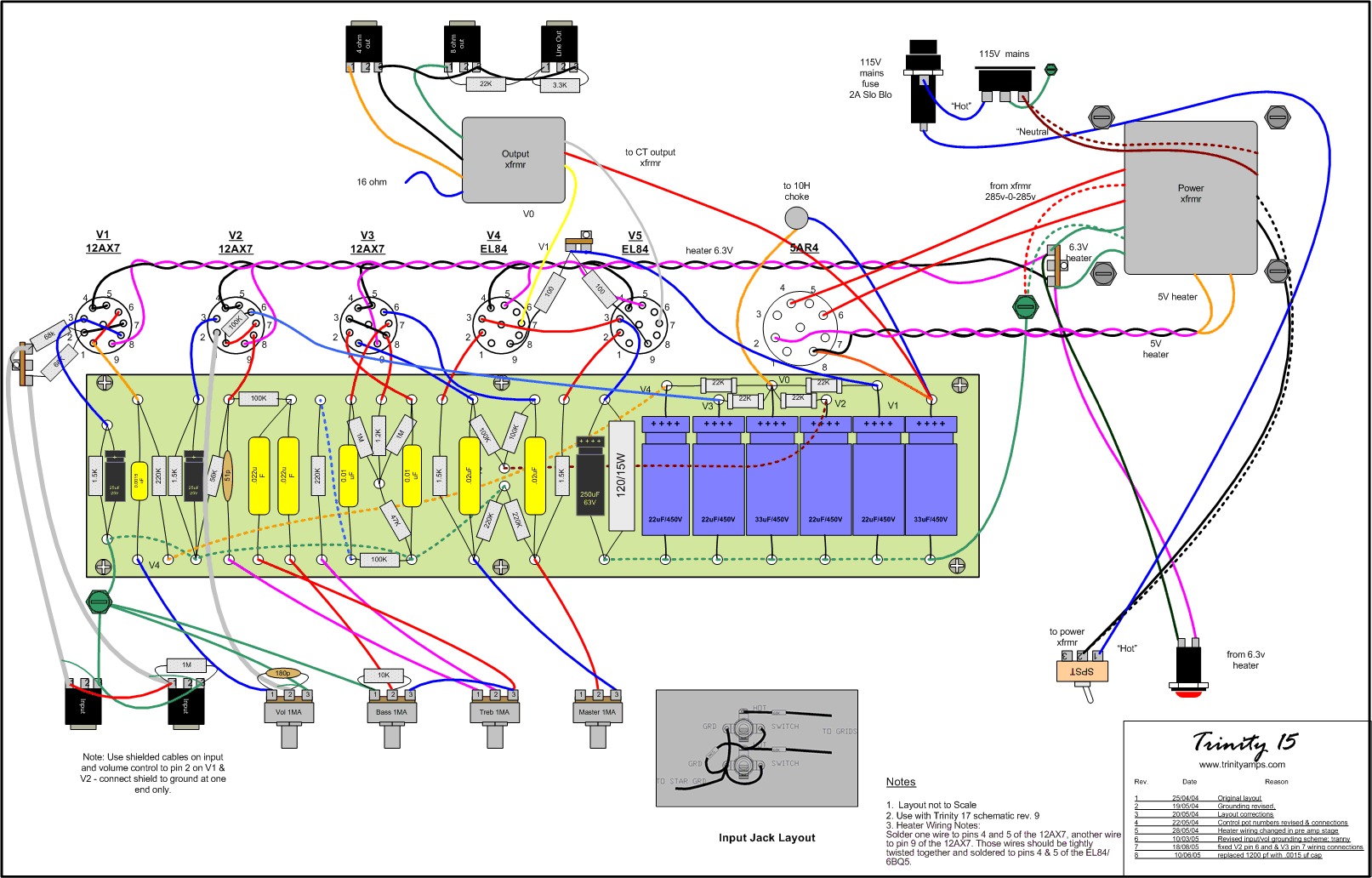
and noticed that pin 8 on the EL84 tubes is not connected, whereas on the schematic above they are tied together.
Which is correct, pin 8 unconneced or pin8 tied to pin 3?
Re: Matchless Clone Modificication - going from 15 to 30 Watts!
It isn't connected to anything on that schem is it.?
I thought 8 in a 84 was an inter. cont.
I thought 8 in a 84 was an inter. cont.
Re: Matchless Clone Modificication - going from 15 to 30 Watts!
I'm not sure if the original was like that, but it would be so that you could remove two output tubes for half power.Structo wrote:I was looking at the Liverpool schematic.
Can anybody explain why the cathodes of the right pair and left pair are not joined?
Yet the two outside are and the two inside are paired to the bypass cap/resistors?