
Sorry, Martin...
I had no other purpose than to point out that he needs the neutral, too, to accomplish what he wants in a safe way.
Ground and neutral i supposed to be connected at the transformer delivery point. As such, it may work with two phase leads and ground, but the ground will then be carrying current, which it absolutely not supposed to do! If anything, this is a clear breach of code, even if I don't pretend to be an expert on US electricity code, by far!
220v to 120v
Moderators: pompeiisneaks, Colossal
-
martin manning

- Posts: 14308
- Joined: Sun Jul 06, 2008 12:43 am
- Location: 39°06' N 84°30' W
Re: 220v to 120v
No worries! But yes it needs a four-wire cable as Paulster described, which (per PM exchange), is not there.

Re: yup
This is the way to do a stage where you have big sound and bright lights and not enough 120V AC power, tap into a dryer or range outlet and split into 2 120s.angelodp wrote:Has two hot legs and a neutral. What about this gadget?
http://www.pnw4x4s.com/forum/index.php?topic=3701.0
Note that in the final version there are breakers, not a bad idea.
Which type of outlet is available ?
Some of the newer type (4 pin) 240V outlets have both neutral and ground.
[img:607:600]http://upload.wikimedia.org/wikipedia/c ... ns.svg.png[/img]
rd

Nema 6-20 correction
Nema 6-20 is what it looks like. But there is no ground to the box just two hots and a neutral. I could put a ground bar into the ground and run that up to the box?
Changed that to read 6-20 240v
Changed that to read 6-20 240v
Re: 220v to 120v
GFCI's do indeed work just fine without a ground. The test circuit is a resistor across line to neutral. The resistor uses a small amount of current thereby upsetting the balance coming out versus going back...i.e. the gfi trips. Nothing is checked to ground.
Also , I have changed 220 (two legs and a ground) back at the panel to 110 by simply moving one of the hot legs to the neutral bus and locating the other on a single pole 20 amp breaker.
Also , I have changed 220 (two legs and a ground) back at the panel to 110 by simply moving one of the hot legs to the neutral bus and locating the other on a single pole 20 amp breaker.
"It Happens"
Forrest Gump
Forrest Gump

Re: 220v to 120v
I just remembered, when I installed a new oven range in our kitchen a few years ago, they said that the new code for 220vac was a four hole receptacle.
Two hots, a neutral and a ground.
Which doesn't make a whole lot of sense, since the neutral and ground go to the same buss in the breaker box.
Ange, to make it safe, you probably need to drive a ground stake near the 220vac outlet if possible.
You can drive it just outside then drill a small hole through the wall to run the wire.
The drier the climate, usually means you need a longer ground stake to get it where the conductivity is better.
Since I used to work construction, whenever I had a question I would find my favorite electrician on the job and pick his brain.
You might see if there are any working on a project nearby and ask.
Two hots, a neutral and a ground.
Which doesn't make a whole lot of sense, since the neutral and ground go to the same buss in the breaker box.
Ange, to make it safe, you probably need to drive a ground stake near the 220vac outlet if possible.
You can drive it just outside then drill a small hole through the wall to run the wire.
The drier the climate, usually means you need a longer ground stake to get it where the conductivity is better.
Since I used to work construction, whenever I had a question I would find my favorite electrician on the job and pick his brain.
You might see if there are any working on a project nearby and ask.
Tom
Don't let that smoke out!
Don't let that smoke out!
-
Gibsonman63
- Posts: 1033
- Joined: Wed May 27, 2009 1:59 pm
- Location: Texas
Re: 220v to 120v
Since you have a NEMA 6-20, you should already have two hots (from two different phases) and a ground. When you install your single phase breaker, it should snap in and attach to one hot and to the nuetral ground bus. Your terminals on the breaker should have provisions for one hot and one nuetral connection. The ground should stay the same. The only caveat is that your nuetral may be red instead of white.
Re: 220v to 120v
In that case it is what is usually done is to wrap the appropriate colored tape around the end of the insulation where it terminates.Gibsonman63 wrote: The ground should stay the same. The only caveat is that your nuetral may be red instead of white.
So for neutral you would use white tape, hot for 220 is either black or red.
Tom
Don't let that smoke out!
Don't let that smoke out!

Re: 220v to 120v
Tom, this is a belt and suspenders approach to safety. The ground is what we call a "redundant neutral." Simply, it is an auxiliary ground should the primary neutral fail for any reason. I'm not an electrician, and am unsure of what NEC says on the matter, but I believe this is now what's required to meet code everywhere in the US.Structo wrote:Two hots, a neutral and a ground.
Which doesn't make a whole lot of sense, since the neutral and ground go to the same buss in the breaker box.
While two hots and one neutral meet the physical requirements needed to resolve Ange's question, it just isn't good enough. He needs a fourth wire to ground.
Ange, I think you really need to consult with a licensed electrician to see if a ground rod will meet requirements and operate properly. IMO, it will be easier to wire it up with GCFI outlets, and again, while I am reasonably sure that solution will operate properly, it is important to verify if the solution meets code requirements.
We are discussing the protection of life and property here. It is not a place to cut corners. You might find a friendly and willing electrician who, for a modest fee will drive by and check your work before closing it up. Ask around.


Re: 220v to 120v
A bonded main panel has the grounds and neutral together (bonded) but a subpanel they must be separated not bonded so one must always consider the panel your working from.
The drop box project seems like a good way to solve the 240v to 120v needed to supply the woodworking equipment. Can always use a power strip between the drop box and equipment as a breaker source.
Mark
The drop box project seems like a good way to solve the 240v to 120v needed to supply the woodworking equipment. Can always use a power strip between the drop box and equipment as a breaker source.
Mark
Safety first
Really appreciate the concern and info guys. I am going to talk to an electrician friend soon and I do think that I can manage this safely.
Possible route
Drive a grounding stake into the ground outside this little building. Then run the ground wire to a dual 120v box ( wall mounted on surface ). Run one of the hot legs and the neutral over to the new box via romex... call it a day. I could also run the additional hot leg in so I have two 20 amp 120v dual sockets. Like the gadget I posted but on the wall. I know its not code but it should be safe and is doable for low low cost. Then I can also run a breaker type power strip as well between the box. Oh... have a friendly electrician eyeball the work for a modest fee.
[IMG 1975]http://i260.photobucket.com/albums/ii9/ ... G_4253.jpg[/img]
Possible route
Drive a grounding stake into the ground outside this little building. Then run the ground wire to a dual 120v box ( wall mounted on surface ). Run one of the hot legs and the neutral over to the new box via romex... call it a day. I could also run the additional hot leg in so I have two 20 amp 120v dual sockets. Like the gadget I posted but on the wall. I know its not code but it should be safe and is doable for low low cost. Then I can also run a breaker type power strip as well between the box. Oh... have a friendly electrician eyeball the work for a modest fee.
[IMG
 1975]http://i260.photobucket.com/albums/ii9/ ... G_4253.jpg[/img]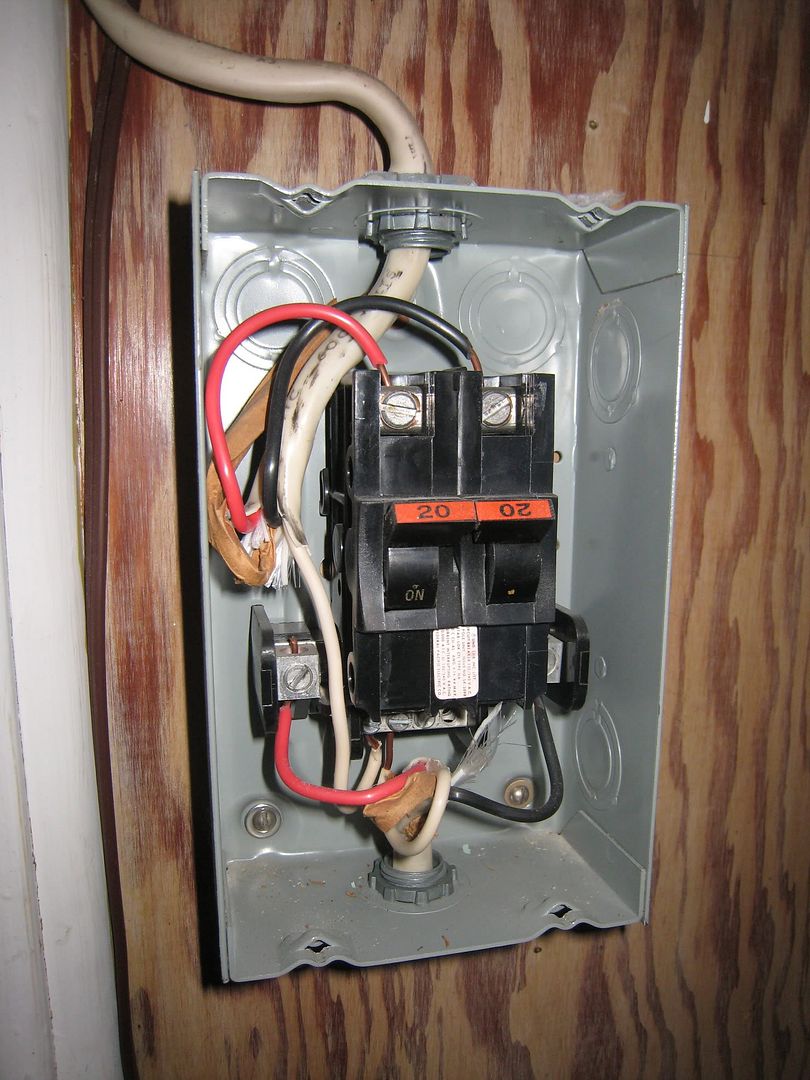
Re: 220v to 120v
Angelo.... if you are certain that your outlet has phases and NEUTRAL, the separate ground wire should be OK, if not exactly code......check with your electrician friend.
Otherwise, there are som potensially dangerous misconceptions here.
Neutral is NOT a "spare" ground wire. Neutral in your 115V outlet is a current carrying wire! It carries the return current from your hot wire!
Ground is supposed to be your safety ground, connected to chassis on your equipment, to divert any shorts from hot wires to ground AND trip your GCFI! Neutral shall NEVER be connected to chassis - EVER!
GCFIs sense the imbalance of the circuit in case there is a leakage in the cicuit, where there are different amount of currents in the hot's or hot/neutral, AND the leakage current is set up between hot and ground, so teh GCFI do indeed need a ground connection. The resistor in the GCFIs are the test resistor, used to set up a leakage current equal to the trip level -it is not permanently in the circuit
The whole idea with neutral in a 3-phase circuit, is that if the current in all 3 phases are equally balanced, the net resulting current in the switch box neutral point will be zero. In practice this is seldom true, and unless the neutral is connected to a common ground point, the single phase voltage between one hot phase and neutral, will be skewed, thus making your 115V anything else but....
NEVER mistake the ground and neutral for being gthe same thing. In case of a serius fault, that just may the last mistake you ever make
Sorry for using CAPITALs, but this is safety in question!
Otherwise, there are som potensially dangerous misconceptions here.
Neutral is NOT a "spare" ground wire. Neutral in your 115V outlet is a current carrying wire! It carries the return current from your hot wire!
Ground is supposed to be your safety ground, connected to chassis on your equipment, to divert any shorts from hot wires to ground AND trip your GCFI! Neutral shall NEVER be connected to chassis - EVER!
GCFIs sense the imbalance of the circuit in case there is a leakage in the cicuit, where there are different amount of currents in the hot's or hot/neutral, AND the leakage current is set up between hot and ground, so teh GCFI do indeed need a ground connection. The resistor in the GCFIs are the test resistor, used to set up a leakage current equal to the trip level -it is not permanently in the circuit
The whole idea with neutral in a 3-phase circuit, is that if the current in all 3 phases are equally balanced, the net resulting current in the switch box neutral point will be zero. In practice this is seldom true, and unless the neutral is connected to a common ground point, the single phase voltage between one hot phase and neutral, will be skewed, thus making your 115V anything else but....
NEVER mistake the ground and neutral for being gthe same thing. In case of a serius fault, that just may the last mistake you ever make
Sorry for using CAPITALs, but this is safety in question!
Re: 220v to 120v
That photo shows a subpanel there is no bond between the main panel and the subpanel. Any connection made to this subpanel will be bonded only to the subpanel.
I'm glad your having an electrician come over, that is the best thing to do.
He could change that subpanel out to a 4 or 8 breaker subpanel and you could have your 120v outlets. You can find recycled panels at Restore Centers or a new one is not that expensive.
Mark
I'm glad your having an electrician come over, that is the best thing to do.
He could change that subpanel out to a 4 or 8 breaker subpanel and you could have your 120v outlets. You can find recycled panels at Restore Centers or a new one is not that expensive.
Mark
Done
Ok, guys, thanks again for your concerns and info. I got a contractor friend to check things out and its all working fine w/ grounded 20amp circuits ( 2 taking each hot leg ) and GFCI receptacles. Pounding in the ground rod was not as bad as I thought, took ten minutes or so with a sledge hammer.
I have my 1969 RAS all set up with a new blade and a cool dust collection system similar to this... very trick
http://www.youtube.com/watch?v=Z9TyYI80 ... re=channel
I also fashioned a Lexan blade guard for the lower portion of the blade that retracts over the fence.
My 1938 Atlas drill press is going great ( thanks to OWWM ) and now its onto the table saw and band saw part of the program.
Cheers Ange
I have my 1969 RAS all set up with a new blade and a cool dust collection system similar to this... very trick
http://www.youtube.com/watch?v=Z9TyYI80 ... re=channel
I also fashioned a Lexan blade guard for the lower portion of the blade that retracts over the fence.
My 1938 Atlas drill press is going great ( thanks to OWWM ) and now its onto the table saw and band saw part of the program.
Cheers Ange
Re: 220v to 120v
Man I miss Norm Abram shows, I love woodworking.
Glad it is all working out Angelo, good to hear that.
Mark
Glad it is all working out Angelo, good to hear that.
Mark