Finished wiring it a few nights ago and did the usual voltage test, then added tubes. All appeared as it should. So the final test, grab the guitar, and let 'er rip.
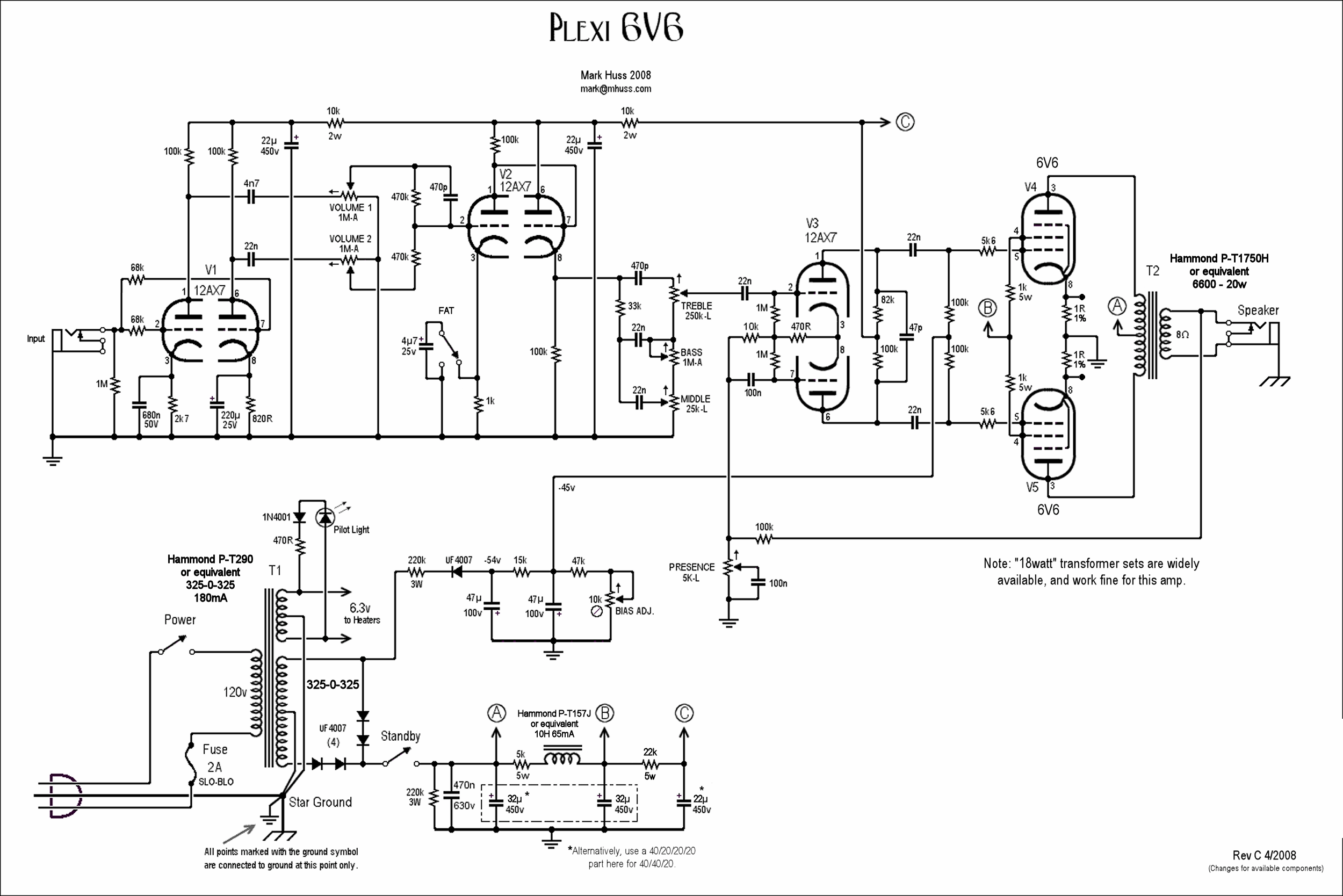
http://mhuss.com/Plexi6V6/Plexi6V6c.gif
It actually sounds great, but there is a constant noise underneath. Verbal descriptions can be vague, but a white noise - ish sound that has a randomness to it, that is constant. Sounds like the ocean. Quiet enough that when I play at a modest level it is hard to hear, loud enough that it is real frickin' annoying when not playing and obviously something is not quite right.
With no instrument cable plugged in it is still there. Volume on ch1 & ch2 does not make it go away. The tone and presence controls alter the eq of the sound, so I am assuming it is before the tone stack and after the volume controls.
I am using the 5v tap on the PT for relays. Bridge rectifier. I have removed the circuit in and out of the relays, but not the supply. Was simply grounding the lead from the wiper on each volume pot or lettign it pass on to the 470K mixing resistors.
I did find some bad caps on the plates from V1. One concern I have is the voltages. B+ (A) is at 465 when powered up with tubes, and about 430 on the screens. Using JJ 6v6s. Using the 1 ohm voltage test on the cathodes, I have it set for 15mA. It does seem to be at the edge of its operating parameters.
I can see the noise with my scope. After the coupling caps on V3 (PI), it is very pronounced. I can also see it on pin 7 of V2 (grid for cathode follower), but not on pin 2 of V2. I am not sure if the signal is simply too small to see at that point. The reading is usually about .5v - 1v. The signal is typical garbage white noise, but then will drift down a few volts as if some dc is biasing it, then it will drift back up around zero, buth with the noise still present.
I have run out of ideas. Thought it might be leaky coupling cap, but now I just don't know. Checked for dc on the pots. Did find the 4n7 off of pin 1 on V1. Re soldered just about everything, even power supply. Checked under the main board for anything loose.
Any ideas anyone?
6v6 plexi, close, but no cigar (OK, now I can light one up)
Moderators: pompeiisneaks, Colossal
6v6 plexi, close, but no cigar (OK, now I can light one up)
Last edited by Stanz on Fri Apr 10, 2009 11:58 pm, edited 1 time in total.
Re: 6v6 plexi, close, but no cigar (OK, now I can light one up)
Since the volume controls don't affect the noise, you know its source is after the first gain stage.
My guess would be, from your description of the noise character, tube noise.
Since you see the noise on the scope at V2b and not v2a, suspect that stage or the plate R for v2a.
My guess would be, from your description of the noise character, tube noise.
Since you see the noise on the scope at V2b and not v2a, suspect that stage or the plate R for v2a.
Rich Gordon
www.myspace.com/bigboyamplifiers
"The takers get the honey, the givers get the blues." --Robin Trower
www.myspace.com/bigboyamplifiers
"The takers get the honey, the givers get the blues." --Robin Trower
Re: 6v6 plexi, close, but no cigar (OK, now I can light one up)
did try tubes, but I can always recheck that.

Re: 6v6 plexi, close, but no cigar (OK, now I can light one up)
Check the orientation of the outer foil of your caps.
Re: 6v6 plexi, close, but no cigar (OK, now I can light one up)
I have seen mention of this but am unfamiliar with how to check and why it is important.
-
Andy Le Blanc
- Posts: 2582
- Joined: Sat Dec 22, 2007 1:16 am
- Location: central Maine
Re: 6v6 plexi, close, but no cigar (OK, now I can light one up)
It depends on the cap type, but in general the outer wrap on a poly cap can act as shield for the signal going thru, and if its turned around will be susceptable to pick up noise. Polarity and markings aren't always trust worthy , and it can really stick out as gain goes up.
What resistor type did you use? That kind of noise can also happen with
carbon types at the tube plates as rfgordon stated.
What resistor type did you use? That kind of noise can also happen with
carbon types at the tube plates as rfgordon stated.
lazymaryamps

Re: 6v6 plexi, close, but no cigar (OK, now I can light one up)
Pin 7 is tied to pin 1 which is the plate of the other triode. As mentioned, the pin 1's plate resistor could be a culprit and pin 3's cathode resistor and fat switch circuit could be related. Does the fat switch increase the noise when engaged?
If it says "Vintage" on it, -it isn't.
Re: 6v6 plexi, close, but no cigar (OK, now I can light one up)
The plate resistors are all carbon film. In looking at the schematic, it dawns on me, the input to V2b is separated from the B+ supply be only the 100k resistor. How the heck does that work? Doesn't that mean the plate voltage from V2a is also on the grid for V2b? Any special type of resistor I should be using there?
Fat switch is not a factor either way.
OK, just read the piece at Aiken's site, I am now up to speed on the outer foil on film caps. Not sure if that is the issue, but will keep it in mind.
Fat switch is not a factor either way.
OK, just read the piece at Aiken's site, I am now up to speed on the outer foil on film caps. Not sure if that is the issue, but will keep it in mind.
Re: 6v6 plexi, close, but no cigar (OK, now I can light one up)
I find the lack of a dc blocking cap between V2a and V2b to be rather disconcerting, though I am no expert. Maybe try one of those.
Exact science is not an exact science
Re: 6v6 plexi, close, but no cigar (OK, now I can light one up)
I have not built a plexi before, but a whole bunch of these have been built over the years. I am more looking for an explanation if anyone has one, more for curiosity than anything else. I do see where KOC never put one there, and he's suffers greatly from engineer-itous (which is a good thing and a bad thing), and is prone to "fix" all sorts of issues because he can. More importantly, looking to get the amp up and running. Right now, I am going back to basics as I have run out of things that I know. Recheck layout and connections ( I seem to have picked up a 120Hz buzz along the way), put back all the stuff I took out as it didn't solve anything. I may end up taking out all wires leading to pots and re doing them, then if it still needs it, all wires to sockets. Also, take the scope test one step further and ground inputs till I see it go away to really pin the source.Ripthorn wrote:I find the lack of a dc blocking cap between V2a and V2b to be rather disconcerting, though I am no expert. Maybe try one of those.
Re: 6v6 plexi, close, but no cigar (OK, now I can light one up)
Guys,
>I find the lack of a dc blocking cap between V2a and V2b to be rather disconcerting, though I am no expert. Maybe try one of those.<
That is a cathode follower (low impedence) that drives the tone stack. Yes it changes the tone to a more throaty / harder tone.
John
>I find the lack of a dc blocking cap between V2a and V2b to be rather disconcerting, though I am no expert. Maybe try one of those.<
That is a cathode follower (low impedence) that drives the tone stack. Yes it changes the tone to a more throaty / harder tone.
John

Re: 6v6 plexi, close, but no cigar (OK, now I can light one up)
Here is what Gabi uses to check the foil of the caps.
Plug it into some type of noise maker amp and flip the switch. Flip the capacitor end for end and test which way is noiser. He has a video on how to use this on youtube.
Mark
Plug it into some type of noise maker amp and flip the switch. Flip the capacitor end for end and test which way is noiser. He has a video on how to use this on youtube.
Mark
You do not have the required permissions to view the files attached to this post.

Re: 6v6 plexi, close, but no cigar (OK, now I can light one up)
Stanz,
My first amp was a MH6V6 Plexi and it is a smokin' amp. Can you post a gut shot? That might help with diagnostics. I made a few small mistakes but sorted these out at startup (with the help of morcey2 and Mark). My amp is pretty quiet aside from a small amount of the usual hiss when it's cranked up. I DC elevated the heaters as a precaution against hum. I did away with the input grid resistor on V1 but may put a 33k back on as I do get some radio interference on occasion, but only when the signal from the guitar is turned down (guitar volume knob all the way off). There is a kind of watery rushing noise when it is doing the RF thing. It is noticeable but not obnoxious, and, as I said, goes away when you turn up the guitar volume. I used a star grounding scheme. I did find the 470k/470k mixing resistor region to be quite microphonic. I installed a VVR so there is an added cap just after the mixing resistors. A piece of shielded wire killed the oscillation/microphony issue.
Anyway, if you want to check out my amp it is at:
http://www.youtube.com/watch?v=2seoikGJZ9g
Perhaps it might help you in some way.
Dave
My first amp was a MH6V6 Plexi and it is a smokin' amp. Can you post a gut shot? That might help with diagnostics. I made a few small mistakes but sorted these out at startup (with the help of morcey2 and Mark). My amp is pretty quiet aside from a small amount of the usual hiss when it's cranked up. I DC elevated the heaters as a precaution against hum. I did away with the input grid resistor on V1 but may put a 33k back on as I do get some radio interference on occasion, but only when the signal from the guitar is turned down (guitar volume knob all the way off). There is a kind of watery rushing noise when it is doing the RF thing. It is noticeable but not obnoxious, and, as I said, goes away when you turn up the guitar volume. I used a star grounding scheme. I did find the 470k/470k mixing resistor region to be quite microphonic. I installed a VVR so there is an added cap just after the mixing resistors. A piece of shielded wire killed the oscillation/microphony issue.
Anyway, if you want to check out my amp it is at:
http://www.youtube.com/watch?v=2seoikGJZ9g
Perhaps it might help you in some way.
Dave
Re: 6v6 plexi, close, but no cigar (OK, now I can light one up)
I did find the 470k/470k mixing resistor region to be quite microphonic. I installed a VVR so there is an added cap just after the mixing resistors. A piece of shielded wire killed the oscillation/microphony issue.
Dave - I had seen your video before, too bad there are no sound clips of it. Looks fantastic though. The microphonic thing is one of the symptoms. It behaves as if there is a microphonic tube, especially if I tap on the top of the chassis. The 470K mixing resistor is within the area of where it seems to be coming from. This amp did fire up and played. Sounded great and can't wait to get it finished. There is a bit of a run, maybe a couple inches of wire, from the 2470K resistors to the grid input. I also had a dpdt relay at that point for the "JCM800" switch, but have since removed it see if that was the issue. This might be an issue.
Brian
Re: 6v6 plexi, close, but no cigar (OK, now I can light one up)
Dave, that was a great video and one heck of a nicely built amp. Got enough switches on that puppy? 
Mark
Mark