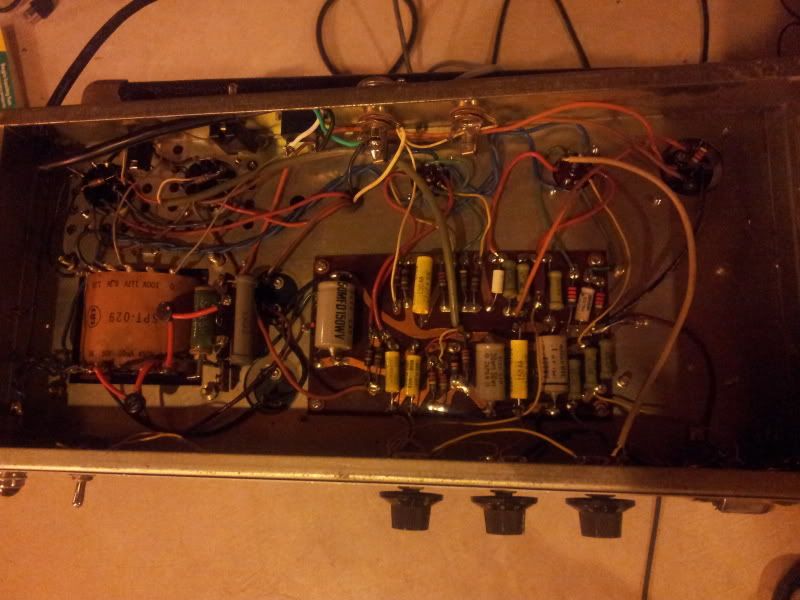
So, I got this old Guyatone GA-940. Runs two 6L6' a 12AX7 and a 12 AT7. About 2 weeks ago, when I first got the amp, it was noisy so i decided to replace the filter caps, the bias cap, and 3 coupling capacitors. I replaced the caps but the noise didn't go away. I contacted the vendor as I suspected the new JJ caps were bad as there was bulging on both of the ones I got, but the supplier assured me that it was fine.
The noise is more of a hiss than a hum. If I remove V2 the noise completely goes away. The Volume knob does affect the loudness of it but if I turned the knob down to the min setting the hiss is still there. and while at its loudest, is not that loud but you can tell its there. If nothing is plugged in you hear it.
Another thing I did tho was to rewire the AC cord I went Live>fuse>switch>PT, White>PT (To a tab labelled "0") and Green to its own bolt on the PT. As soon as I rewired I turned the amp on for about 2 minutes and I got a big spark. I unplugged immediately and noticed that the power switch was loose and wasn't fully making ground contact. I tightened it up and it started working somewhat ok. It always hisses and for like a split second or two but now I also get random hum. Not much but every so often I get hum, and its the kind that I associate with bad filter caps.
The amp sounds good and the hiss is not noticeable when you play but when you stop playing its there.
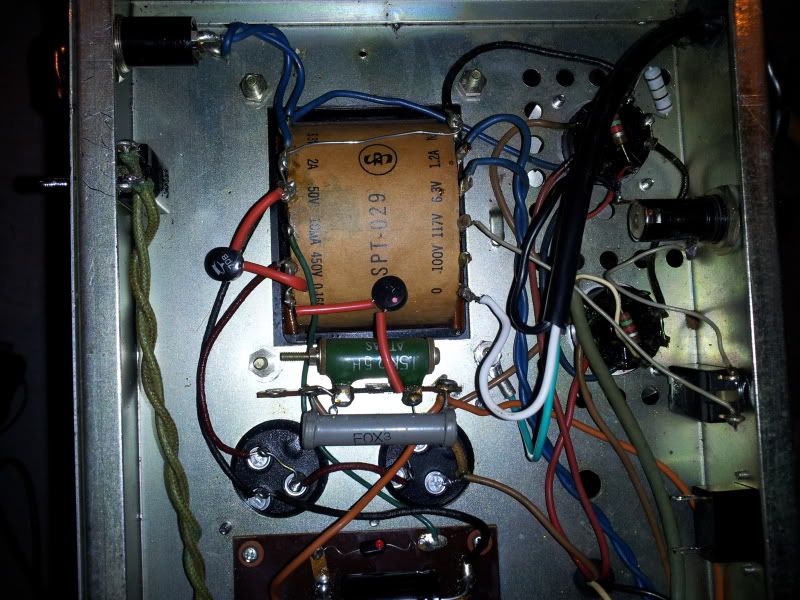
The PT has a tap that says "450 V" and that feeds the filter caps. I don't see any diodes around and there is no rectifier so this is actually confusing a bit, does this mean this PT outputs DC? I measured voltage on the caps and the voltage was around 1000 volts. (They're wired in series and each one is 100 UF, @ 500 Volts. I measured the plate on V4 and it was at about 525 (Can't remember right off the top of my head but it was around that)
I started measuring on V1 and got for
pin 1 307 Volts
pin 2 - 0 Volts
pin 3 - 3 V
I stopped because I was getting this really loud crackle when taking the readings from V1, plus my hand was a little shaky at the time so I decided I would wait and do it safely later on. Especially after reading the 1000 + volts on the filter caps I didn't think my meter could read that high of a voltage. Thought it would fry but it didnt.
Please have a look at the PT and let me know if this PT in fact, outputs DC? And where should I start troubleshooting the hiss? Im upset because with shipping I just spent $90 bucks worth of caps that didn't really fixed what was wrong with the amp to begin with...
Before
[IMG:800:600]http://i114.photobucket.com/albums/n271 ... 214535.jpg[/img]
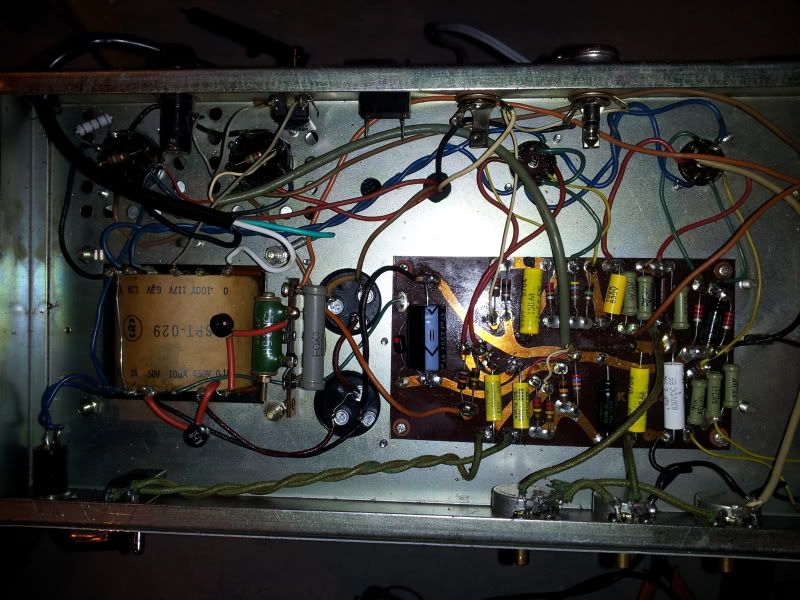
After
[IMG:800:600]http://i114.photobucket.com/albums/n271 ... 181327.jpg[/img]
[IMG:800:600]http://i114.photobucket.com/albums/n271 ... 182209.jpg[/img]
Vintage Japanese amp issues...
Moderators: pompeiisneaks, Colossal

Re: Vintage Japanese amp issues...
Aren't those things with the red on the leads (708) the rectifier diodes?
Did you replace the cap cans which are the main filters?
The hiss may be the carbon comp resistors on the plates of the preamp.
Also, if the input jack does not short to ground, it will cause the amp to hiss with no guitar plugged in.
Make sure your battery in your meter is fresh or it will give false readings.
Did you replace the cap cans which are the main filters?
The hiss may be the carbon comp resistors on the plates of the preamp.
Also, if the input jack does not short to ground, it will cause the amp to hiss with no guitar plugged in.
Make sure your battery in your meter is fresh or it will give false readings.
Tom
Don't let that smoke out!
Don't let that smoke out!
Re: Vintage Japanese amp issues...
I don't know if those are the diodes but that wouod make sense. For some reason I dont remember reading voltage there but It is connected to the can cap. So I guess.
So my best bet for now is to replace the plate load resistors then? I did check the input jacks and they are all grounded.
The voltage seems high tho' but I guess I dont even know what it should be for starters.. : S
So my best bet for now is to replace the plate load resistors then? I did check the input jacks and they are all grounded.
The voltage seems high tho' but I guess I dont even know what it should be for starters.. : S
-
Cliff Schecht
- Posts: 2629
- Joined: Wed Dec 30, 2009 7:32 am
- Location: Austin
- Contact:
Re: Vintage Japanese amp issues...
Many of the components used in those old Jap radios are notorious for being problematic. I had a Japanes reel-to-reel e tape recorder that I stripped for parts because I thought the R's and C's looked cool. Many of the parts I pulled tested out of spec or completely useless. I'd replace all resistors that you can't verify are good with a DMM (tubes pulled) or you can't check without pulling them out of the circuit.
Also those big dog bone resistors in the power section are notorious for being bad. I've quit using them as well, they seem to eventually fail from age and light stress.
Also those big dog bone resistors in the power section are notorious for being bad. I've quit using them as well, they seem to eventually fail from age and light stress.
Cliff Schecht - Circuit P.I.
Re: Vintage Japanese amp issues...
Ok, ill start swapping resistors. First, I'll do the plate load resistors on V1 then ill swap them as needed. I also need fo replace the fuse- theres a 4 amp fuse in there and the amp calls for a 2 amp.
I do hear random static, not much but I hear it...
The amp does sound pretty good tho... What should be the max voltage a 6L6 can handle safe?
I do hear random static, not much but I hear it...
The amp does sound pretty good tho... What should be the max voltage a 6L6 can handle safe?
Re: Vintage Japanese amp issues...
maybe I should replace all of the plate load resistors including the power tubes they probably have just drifted so much and that is the reason that the voltage is so high.
Re: Vintage Japanese amp issues...
Also, being that tbe caps are wired in series then is it normal that the voltage is around 1000 volts? That just sounds so dangerous...
-
Cliff Schecht
- Posts: 2629
- Joined: Wed Dec 30, 2009 7:32 am
- Location: Austin
- Contact:
Re: Vintage Japanese amp issues...
If there is 1000V anywhere in this amp then you have yourself a real stinker. Unless you have some Eimac ceramic tubes there really aren't a lot of audio tubes meant to take that kind of abuse.
Series caps aren't uncommon. Look in most 100W Marshall's and you'll see the cap stacks. Make sure there's balancing resistors across the caps though, if these resistors aren't present then one cap can be forced to see more voltage than it's rated for.
Speaking of which, if there's a lot of really high voltage throughout this amp this is hard on most components.
I don't run 6L6's above about 450-460V but I've ran 5881's at close to 600V without hurting them (was only momentarily and they were biased for this).
If I can help it I don't change resistors or really any parts unless I can verify they are bad. In many cases you can do this in circuit. With that said, I don't trust old Japanese electronics components very much anymore. The iron itself works fine, mainly the R's and C's have let me down.
Series caps aren't uncommon. Look in most 100W Marshall's and you'll see the cap stacks. Make sure there's balancing resistors across the caps though, if these resistors aren't present then one cap can be forced to see more voltage than it's rated for.
Speaking of which, if there's a lot of really high voltage throughout this amp this is hard on most components.
I don't run 6L6's above about 450-460V but I've ran 5881's at close to 600V without hurting them (was only momentarily and they were biased for this).
If I can help it I don't change resistors or really any parts unless I can verify they are bad. In many cases you can do this in circuit. With that said, I don't trust old Japanese electronics components very much anymore. The iron itself works fine, mainly the R's and C's have let me down.
Cliff Schecht - Circuit P.I.
Re: Vintage Japanese amp issues...
Trace yourself the schematic and put the idle voltage on it for all of us to see. Then we might be able to help better.
He who dies with the most tubes... wins
-
renshen1957

- Posts: 498
- Joined: Fri Feb 20, 2009 8:13 am
- Location: So-Cal
Re: Vintage Japanese amp issues...
I would second the CC Resistors as the cause of the hiss. I'd suggest replacing with metal film resistors for the plate. Ken Fischer recommended 1 Watt Metal Films when he was writing about amp repairs back in the day.Structo wrote:Aren't those things with the red on the leads (708) the rectifier diodes?
The hiss may be the carbon comp resistors on the plates of the preamp.
Steve
Re: Vintage Japanese amp issues...
Thx all for the input. I put a fresh battery on my meter and my readings are normal. I got about 470 on the plate and -40 on the Cathode. There's no 1k voltage anywhere. The battery on my meter was the original from when I bought it 3 years ago. So, im gonna run to the electronics store see if I can get there before they close so I can get some resistors for V1 and V2,ill report back on the noise.