how do you route your PT wires?
Moderators: pompeiisneaks, Colossal

Re: how do you route your PT wires?
Complete overkill and not necessary to put that much effort into twisting wires unless you have OCD.
Re: how do you route your PT wires?
Twisting the the teflon just takes practice, you'll get the hang of it!
Re: how do you route your PT wires?
Hell, Soldano doesn't twist heaters at all between tubes...they aren't even insulated, and that's in high-gain designs. And, yes, it's still AC heaters in an SLO.wsaraceni wrote:isn't that a little overkill though? (and pretty sloppy looking)
i mean the komet is twisted 10x as much as a trainwreck and neither amp have a bunch of hum. i don think i've seen many amps twisted that tight and that close to the tube socket.
Re: how do you route your PT wires?
Well the insulation doesn't matter, but SLOs so hum quite a bit. Just sayin'.
-
diagrammatiks
- Posts: 558
- Joined: Sun Mar 27, 2011 12:28 am
Re: how do you route your PT wires?
their base level of hum with no cord in the input isn't any more then any other boutique amp.
off the top of my head I know that bogner and mesa don't twist either.
There's almost no difference between a sloppy twist and no twist.
There's way too much focus on heater wiring when it's not that big of a deal at all.
off the top of my head I know that bogner and mesa don't twist either.
There's almost no difference between a sloppy twist and no twist.
There's way too much focus on heater wiring when it's not that big of a deal at all.
Re: how do you route your PT wires?
Well, I'm not gonna argue with that, the amount of hum in most boutique amps is pretty suprising, even low gain ones like Divided by 13, for example.diagrammatiks wrote:their base level of hum with no cord in the input isn't any more then any other boutique amp.
off the top of my head I know that bogner and mesa don't twist either.
There's almost no difference between a sloppy twist and no twist.
There's way too much focus on heater wiring when it's not that big of a deal at all.
I also agree a sloppy twist is probably worse than the parallel method. I've had the best luck with elevating the wiper of a humdinger and nulling the hum that way, but I always try to twist the wires textbook style for good measure.
What's given you the best success, Diagrammatiks?
-
diagrammatiks
- Posts: 558
- Joined: Sun Mar 27, 2011 12:28 am
Re: how do you route your PT wires?
I usually run parallel lines and elevate with a humdinger, 100ohm matched resistors.
I twist the wires with a dril that need to go from the transformer to the first pins of the power tubes.
Then I'll twist again to go from the power tube to the preamp tubes.
The thing about the slo is that there's no where to push the wires if they do twist.
There's probably some noise reduction that can be achieved if they twisted and lifted the wires up above the sockets. However, the usual method of pushing towards the chassis doesn't work because the heaters end up right under the pots or right under the circuit board.
In a push/pull amp the power tubes will cancel hum if they are biased to match each other so power tubes really never need to be twisted.
If you look at all the literature and the math behind it, it's actually very hard to twist and wire correctly to achieve any noticeable noise reduction over straight wiring. That being said there will of course be a big improvement over just doing it plain wrong.
People forget that a lot of the heater wiring techniques come from circuits where there are tons of different sized tubes running all over the place.
If you got the sockets all in a line it really is negligible.
I twist the wires with a dril that need to go from the transformer to the first pins of the power tubes.
Then I'll twist again to go from the power tube to the preamp tubes.
The thing about the slo is that there's no where to push the wires if they do twist.
There's probably some noise reduction that can be achieved if they twisted and lifted the wires up above the sockets. However, the usual method of pushing towards the chassis doesn't work because the heaters end up right under the pots or right under the circuit board.
In a push/pull amp the power tubes will cancel hum if they are biased to match each other so power tubes really never need to be twisted.
If you look at all the literature and the math behind it, it's actually very hard to twist and wire correctly to achieve any noticeable noise reduction over straight wiring. That being said there will of course be a big improvement over just doing it plain wrong.
People forget that a lot of the heater wiring techniques come from circuits where there are tons of different sized tubes running all over the place.
If you got the sockets all in a line it really is negligible.
Re: how do you route your PT wires?
Thanks. Yeah, I've run the power tube parallel, but been a little scared to them SLO style. I guess you're right, that under the pots wouldn't be so great. What do you use, 20AWG buss wire?
-
diagrammatiks
- Posts: 558
- Joined: Sun Mar 27, 2011 12:28 am
Re: how do you route your PT wires?
I use 18.
The only other size I can get cheaply is 22 or else I'd use 20.
The only other size I can get cheaply is 22 or else I'd use 20.
Re: how do you route your PT wires?
Thanks, I'm about to build my first "tubes up front" amp, and am gonna give it a go.
-
diagrammatiks
- Posts: 558
- Joined: Sun Mar 27, 2011 12:28 am
Re: how do you route your PT wires?
if you really want to cover all your bases you can lift the wires up and over between the sockets like aiken does.
http://t3.gstatic.com/images?q=tbn:ANd9 ... Q5ntWKTpaw
http://t3.gstatic.com/images?q=tbn:ANd9 ... Q5ntWKTpaw
Re: how do you route your PT wires?
I dunno, you don't think that's worse with the tubes up front, putting them closer to the flying leads to the pots and pots themselves? Seems like in the corner would be better.
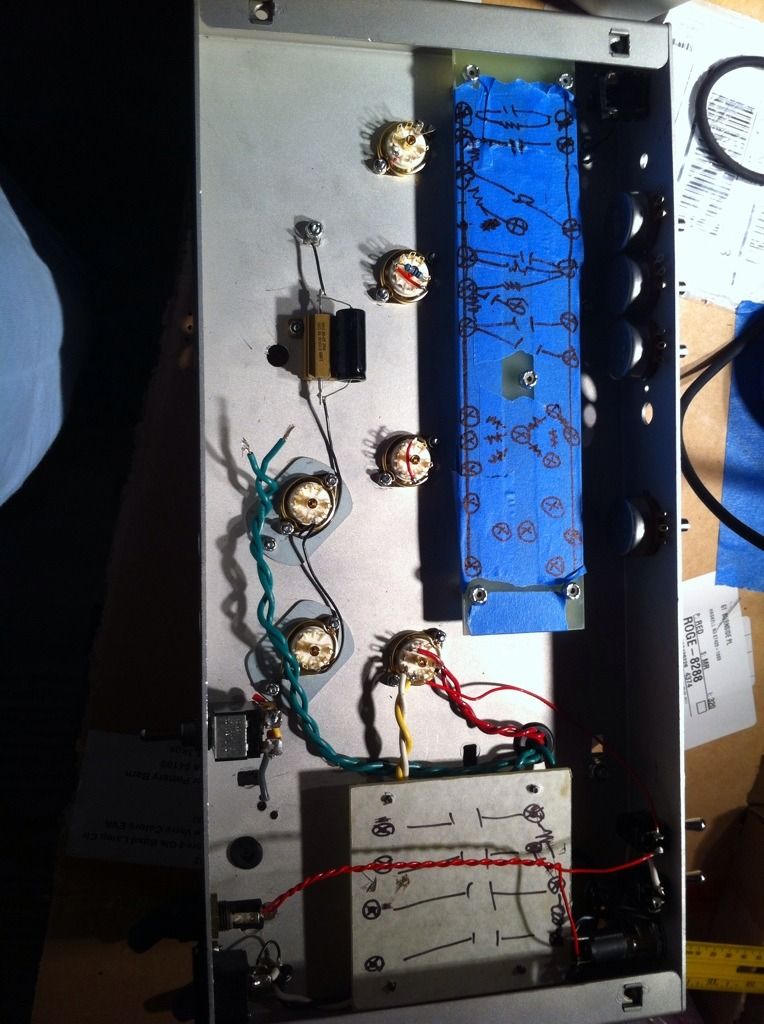
Re: how do you route your PT wires?
Gaz,
I have done something similar, I call it tubes under--it helped me to keep leads really short on a high gain amp.
I have done something similar, I call it tubes under--it helped me to keep leads really short on a high gain amp.
You do not have the required permissions to view the files attached to this post.