
I was wondering if any of you have done this?
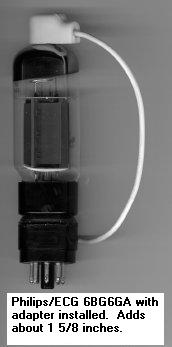
The 6BG6GA is a equivalent substitute for the 6L6GC except you have to do a little rewiring or make adapter plugs.
It has it's plate connection at the top of the tube so you need a wire and cap for that.
Pin 3 is the cathode and pin 8 is the screen and pin 5 is the grid.
6BG6GA:
TC1 = a
1 = N/C
2 = h
3 = k
4 = N/C
5 = g
6 = N/C
7 = h
8 = g2
6L6GC
1 = Shell
2 = h
3 = a
4 = g2
5 = g
6 = N/C
7 = h
8 = k
The deal is, you can get these tubes for around $10 ea.
$48 for a matched quad.
They can also handle higher plate and screen voltages.
[img:172:347]http://www.vacuumtubes.com/adapt.jpg[/img]
This guy claims that they sound just like the Sylvania 6L6 from the 60's.
http://www.vacuumtubes.com/6BG6.html
The 6BG6GA, an alternative to the 6L6GC?
Moderators: pompeiisneaks, Colossal
The 6BG6GA, an alternative to the 6L6GC?
Tom
Don't let that smoke out!
Don't let that smoke out!
-
Cliff Schecht
- Posts: 2629
- Joined: Wed Dec 30, 2009 7:32 am
- Location: Austin
- Contact:
Re: The 6BG6GA, an alternative to the 6L6GC?
Yup very similar if not identical structures to 6L6GC's with the anode brought out to a pin on top. It's very much like the 807's I use with maybe 5-10W more plate dissipation if you buy the right ones. I think the ones you are looking at specifically are identical to a famed 6L6GC and can handle 30W plate dissipation. You have to look at the internal structures to see if it's a true GC copy or not, the tube is actually only rated at about 20W but some can handle a lot more than that.
FWIW I've ran 807's hot as shit and am yet to hurt one. They're military tubes (the 807's, not sure about the 6BG6 here) and are very well built. I've had 6L6WGB's that were just as durable but there is a difference in sound compared to a plate-cap based tubes. The lower inter-electrode capacitance I think is the biggest player here (think reduced Miller capacitance means the tube is both easier to drive cleanly and has a higher bandwidth).
Only real problem with the 807 is how tall they are; you add in an adapter to fit it into a standard 6L6 socket at you are at 8-10 inches tall! I think the 6BG6 with adapter is much more reasonable in this respect but be forewarned, the plate cap and adapter do add height that can screw you if you aren't paying attention to such details!
Also remember this is an RF tube so it's smart to put a 10 Ohm resistor with 10 wraps of wire connected right onto the plate cap connector. It acts like a low Q inductor to snub high frequencies and help kill RF oscillations. I run 807's like this because sometimes it's hard to trace out RF oscillations even with a good scope!
FWIW I've ran 807's hot as shit and am yet to hurt one. They're military tubes (the 807's, not sure about the 6BG6 here) and are very well built. I've had 6L6WGB's that were just as durable but there is a difference in sound compared to a plate-cap based tubes. The lower inter-electrode capacitance I think is the biggest player here (think reduced Miller capacitance means the tube is both easier to drive cleanly and has a higher bandwidth).
Only real problem with the 807 is how tall they are; you add in an adapter to fit it into a standard 6L6 socket at you are at 8-10 inches tall! I think the 6BG6 with adapter is much more reasonable in this respect but be forewarned, the plate cap and adapter do add height that can screw you if you aren't paying attention to such details!
Also remember this is an RF tube so it's smart to put a 10 Ohm resistor with 10 wraps of wire connected right onto the plate cap connector. It acts like a low Q inductor to snub high frequencies and help kill RF oscillations. I run 807's like this because sometimes it's hard to trace out RF oscillations even with a good scope!
Cliff Schecht - Circuit P.I.